

Contents
- 1. Key Takeaways
- 2. The Myth of the Full-Time Hire
- 3. What the Numbers Actually Say
- 4. You Were Not Created to Manage Your Own Calendar
- 5. Which Roles Actually Belong In-House
- 6. Why "Smart" CEOs Specifically Choose VAs Over Staff
- 7. The Real Cost Comparison
- 8. But Doesn't Delegating Mean Losing Control?
- 9. What Changes in the First Quarter
- 10. How Smart CEOs Make the Shift
- 11. FAQs
- 11.1. Is a virtual assistant really a substitute for a full-time employee?
- 11.2. Will I actually save money compared to hiring staff?
- 11.3. How do I keep quality and control with a remote assistant?
- 11.4. How fast can a CEO get started?
- 11.5. What’s the biggest mistake CEOs make when delegating for the first time?
- 12. Conclusion
Key Takeaways
- The most expensive hire isn't always the most valuable one — and a full-time salary is rarely the smartest way to buy back a leader's time.
- Smart CEOs aren't cutting corners by hiring virtual assistants; they're protecting their highest and best use.
- Businesses save up to 78% on operational costs by using virtual assistants instead of full-time in-house staff.
- A CEO who delegates well doesn't lose control — they multiply their capacity.
- The question isn't whether you can afford a VA. It's whether you can afford to keep doing what only a VA should be doing.
"Your value is not measured by how busy you are. It is measured by what you produce." — a principle the late Dr. Myles Munroe taught for decades on potential and purpose, and one that has never been more relevant to how leaders spend their hours.
Let me say something plainly, because leaders need plain truth.
The CEO who insists on doing everything is not a hero. They are a bottleneck wearing a crown.
For years, the corporate world has worshipped the full-time hire as the answer to every growing pain. More work? Add a head. More pressure? Add a salary. But a new generation of sharp, disciplined leaders has started asking a better question — not “who can I put on payroll?” but “what is the wisest way to release my own capacity?”
And increasingly, the answer is the virtual assistant.
In this post, we’ll walk through why the smartest CEOs are choosing dedicated virtual assistants over traditional full-time staff, what it’s really costing leaders who refuse to delegate, the kinds of roles that make sense to outsource versus keep in-house, and how to make the shift without losing control of your business.
The Myth of the Full-Time Hire
There is a belief, deeply rooted, that the way to grow is to keep adding full-time bodies to the building.
It feels like progress. A bigger team. More desks. More salaries on the books. It looks like success.
But appearance and substance are not the same thing.
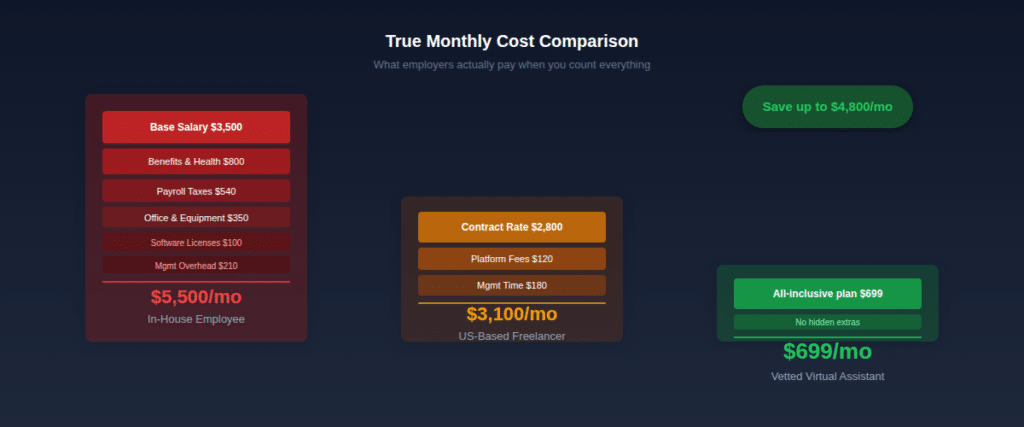
A full-time employee is not just a salary. They are payroll taxes. Benefits. Office space. Equipment. Software licenses. Onboarding time. Management overhead. When you factor in everything, the true cost of a US-based in-house employee is roughly 2.5 times higher than a dedicated offshore virtual assistant doing comparable work.
The smart CEO sees this clearly. They understand that adding overhead is not the same as adding value — and that the goal was never to build a bigger payroll. The goal was always to build a freer leader and a more productive business.
Consider how this plays out over a single hiring decision. A growing company needs help managing customer inquiries, scheduling, and basic reporting. The instinct is to post a job for an “Executive Assistant” or “Operations Coordinator” — a full-time role with a salary, benefits, a desk, a laptop, and a multi-week hiring process before anyone starts. Three months later, after recruiting costs and onboarding time, the company has added a fixed monthly cost of several thousand dollars and a long-term obligation, to handle a workload that may shrink or change shape within a year. The alternative — bringing in a specialized virtual assistant for the same scope of work — can be running within 48–72 hours, at a fraction of the cost, with the flexibility to scale up or down as the business actually requires.
Neither approach is inherently wrong. But only one of them matches the pace at which most growing businesses actually change.
What the Numbers Actually Say
I am not asking you to take this on faith. The evidence is overwhelming, and it is recent.
Businesses report saving up to 78% on operational expenses by hiring virtual assistants instead of full-time in-house staff. One survey found that 43% of managers said their teams regained at least 10 hours per week after delegating tasks to a VA. Early-stage companies that bring on VA support reduce founder workload by 15 to 20 hours every single week.
And this is not a fringe practice anymore. Roughly 35% of executives now use virtual assistants for scheduling, email, and coordination, and nearly half of large companies with over 1,000 employees rely on them. According to one industry report, more than 70% of leaders now lean on assistants of some kind to function at their level.
This is not a trend. It is a structural shift in how serious leaders staff their lives.
What’s notable is where this shift is happening fastest. It’s not primarily large enterprises with existing HR infrastructure — it’s small and mid-sized businesses, solo founders, and growing teams who don’t have the luxury of a slow hiring process or a six-figure operations budget. For these leaders, the virtual assistant model isn’t a downgrade from “real” staffing. It’s often the first time they’ve had access to dedicated, specialized support at all.
You Were Not Created to Manage Your Own Calendar
Here is a truth I want to settle deep within you.
Every leader carries an assignment — something only they were positioned to do. The vision. The relationships. The decisions that move the whole organization forward. That is your domain. That is your design.
But somewhere along the way, many CEOs became prisoners of their own administration. They spend their best, sharpest, most strategic hours buried in the kind of work a trained assistant could handle with excellence.
That is not leadership. That is a leader functioning beneath their assignment.
When you hand off calendar management, email triage, data entry, and customer support to a dedicated virtual assistant, you are not surrendering control. You are reclaiming your design.
This isn’t only a matter of principle, either. Harvard Business Review has long noted that one of the hardest transitions for any leader is the shift from doing to leading — and that how you involve others ultimately sets the ceiling on your impact.
Think about the leaders you admire most — in your industry or otherwise. It’s unlikely that what makes them effective is their ability to keep an organized inbox or respond to messages within minutes. What makes them effective is almost always something else entirely: a clear sense of direction, the relationships they’ve built, the calls they’re willing to make when the answer isn’t obvious. Every hour spent on tasks that don’t draw on those strengths is an hour that quietly narrows the gap between who you are and who your role requires you to be — except in the wrong direction.
Which Roles Actually Belong In-House
None of this means every role should be outsourced, and a leader who tries to delegate everything indiscriminately will run into a different kind of trouble. The skill isn’t in delegating more — it’s in delegating correctly.
As a general guide, roles tend to make sense to keep in-house when they involve:
Deep institutional knowledge that takes years to build. A long-tenured operations lead who understands the history behind every process, vendor relationship, and client quirk carries context that’s expensive and slow to replicate externally.
Physical presence as a core requirement. Roles that depend on being in a specific location — managing a physical retail space, running equipment, meeting clients in person — aren’t good candidates for remote delegation, almost by definition.
Direct legal or fiduciary responsibility. Positions that carry signing authority, regulatory accountability, or fiduciary duty typically need to sit with someone embedded in the organization’s legal structure, not an external contractor.
Strategic ownership of relationships that define the business. A handful of key client or partner relationships may be central enough to the business that the CEO — or a senior in-house leader — needs to own them directly, even if the administration around those relationships gets delegated.
Everything else — and for most growing businesses, that’s a substantial list — is fair game for a structured delegation strategy. The goal isn’t an empty org chart. It’s an org chart where every in-house seat is justified by something only an in-house person could do.
Why "Smart" CEOs Specifically Choose VAs Over Staff
Notice the word in the title: smart. This is a deliberate choice by disciplined leaders, not a desperate cost cut. Here’s the reasoning behind it.
Flexibility without the long-term burden
A full-time hire is a long-term commitment with fixed cost, regardless of how your workload rises and falls. A virtual assistant can scale with your needs — part-time when things are quiet, full-time when you’re growing — without recruitment fees or severance complications.
This flexibility matters more than it might first appear. Businesses rarely grow in a straight line. A product launch, a seasonal spike, or a new market entry can temporarily double the administrative workload — and then settle back down a few months later. A full-time hiring decision made in the middle of that spike often leaves a business overstaffed once things normalize. A flexible support model absorbs the spike without locking in a permanent cost that outlives the need.
Specialized skill, immediately
The modern VA is not a generalist filling a chair. Today, the majority of VA roles require specific specialization. Smart CEOs can bring on someone already fluent in bookkeeping, social media, or real estate workflows — no months of training required.
This is a meaningful shift from how outsourcing used to work. A decade ago, “virtual assistant” often implied a generalist handling miscellaneous admin with minimal industry context. Today, specialization is the norm — which means the time a CEO would otherwise spend training someone from scratch is largely eliminated.
Dramatically lower true cost
Without office space, equipment, benefits, and payroll taxes, a US employer can save over $11,000 per year per VA hired. That is capital a wise leader redirects toward growth, product, and people who truly belong in-house.
Focus restored to the founder
This is the one that matters most. Every hour a VA absorbs is an hour returned to the work only the CEO can do — vision, strategy, relationships, and the decisions that determine whether the business thrives.
The Real Cost Comparison
Let’s put it side by side, plainly:
| Offshore Virtual Assistant | US-Based VA | In-House Employee | |
|---|---|---|---|
| Starting price | $699/month | $3,500/month | $4,000/month |
| Recruitment fees | $0 | $0 | $500–$5,000 |
| Office & equipment | None | None | Significant |
| Benefits & payroll tax | None | None | Required |
| Scale up or down | Easily | Limited | Difficult |
| Pre-vetted talent | Yes (with a reputable provider) | May vary | May vary |
A typical virtual assistant pricing page is a useful reference point for what this looks like in practice — plans commonly start around $699/month with no recruitment fees and no long-term lock-in required.
But Doesn't Delegating Mean Losing Control?
This is the fear that keeps many leaders chained to tasks beneath them. Let me address it directly, because fear left unexamined becomes a prison.
Delegation is not abdication.
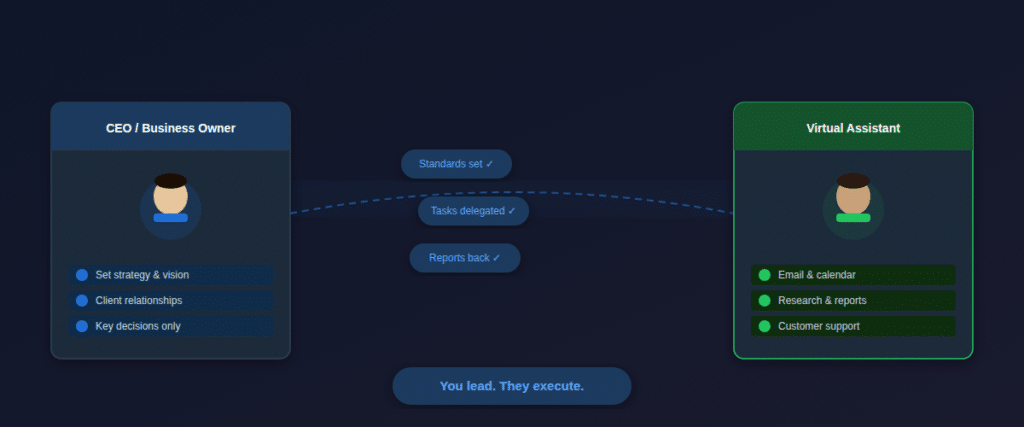
When you delegate well, you do not hand away your authority — you extend it. You remain the one who sets direction, defines standards, and holds the vision. The VA simply carries what you should never have been carrying in the first place.
The principle is ancient. When Moses tried to judge every dispute among two million people himself, his father-in-law Jethro warned him he would wear himself out and fail the very people he was called to serve. The solution was not for Moses to work harder. It was to find capable people, give them clear responsibilities, and reserve himself for what only he could do.
A virtual assistant is that principle, made practical for the modern leader. You don’t lose control. You finally gain the bandwidth to lead.
There’s a useful distinction here between control and involvement. Control is about who sets direction, who defines what “good” looks like, and who has final say. Involvement is about who personally executes each step. A CEO can maintain full control — setting the standards, reviewing the outcomes, making the calls that matter — while reducing their involvement in the execution itself. Most leaders who fear “losing control” are actually describing a fear of losing involvement, which is a very different thing. Involvement in low-leverage tasks isn’t control. It’s just occupied time.
What Changes in the First Quarter
It’s worth being honest about the arc of this transition, because the benefits don’t arrive all at once — and leaders who expect an overnight transformation sometimes give up just before the real shift happens.
In the first few weeks, the primary change is informational. Tasks that used to live entirely in the CEO’s head — “I need to follow up with that vendor,” “remind me to review the Q3 numbers Friday” — start moving into shared systems. This alone often surfaces things that had quietly been falling through the cracks.
By the second month, a rhythm starts to form. The VA has handled enough recurring situations to make judgment calls within the boundaries the CEO set, without needing to ask each time. This is the point where the time savings start to feel real rather than theoretical.
By the third month, many leaders report something subtler but more significant: a change in how they think about their own time. Tasks that used to trigger an automatic “I’ll just do this myself” now trigger a different question — “does this need to be me?” That shift in instinct, more than any single hour saved, is often what separates leaders who get lasting value from delegation and those who quietly slide back into doing everything themselves.
How Smart CEOs Make the Shift
Wisdom is not just knowing the right thing. It is doing it in the right order. Here’s how disciplined leaders bring on a VA without chaos.
- Audit your week. Track where your hours actually go. Most leaders are shocked to find 15 to 20 hours swallowed by work they were never meant to touch.
- Identify your “only you” work. Name the handful of things only the CEO can do. Everything else is a delegation candidate.
- Start with a real conversation, not a generic signup. A provider worth working with will want to understand your business, your workload, and where you’re losing the most time — not just slot you into a one-size-fits-all package.
- Get matched and onboard properly. Look for a process that pairs you with someone experienced in your industry and includes structured onboarding — typically within 48–72 hours — so they’re productive from week one rather than month two.
FAQs
Is a virtual assistant really a substitute for a full-time employee?
For a large share of administrative, operational, and specialized support work, yes. Many tasks once handled by in-house staff — scheduling, email, bookkeeping, customer support, research — are now performed by VAs at a fraction of the cost. For roles that require physical presence or deep institutional ownership, a full-time hire may still make sense; the smart move is to delegate everything that doesn’t truly require one.
Will I actually save money compared to hiring staff?
In nearly every case. Businesses report saving up to 78% on operational expenses, and a US employer can save over $11,000 per year per VA when you factor in office space, equipment, benefits, and payroll taxes. Reputable providers commonly offer plans starting around $699/month with no recruitment fees.
How do I keep quality and control with a remote assistant?
You set the standards, workflows, and communication cadence during onboarding, and you should communicate directly with your VA — no middleman. With a reputable provider, every VA is pre-vetted and matched to your industry, and there’s a clear escalation point if anything needs adjusting.
How fast can a CEO get started?
This depends on the provider, but a well-run service should be able to match you with a dedicated VA within 48–72 hours of an initial conversation, followed by a guided onboarding session.
What’s the biggest mistake CEOs make when delegating for the first time?
Delegating too vaguely. Handing someone a task with no defined scope, no example of what “done” looks like, and no agreed communication rhythm sets both the CEO and the VA up for frustration — not because the VA isn’t capable, but because they’re being asked to read minds. The leaders who get the most value from delegation are the ones who invest a little time upfront making expectations explicit, even for small tasks.
Conclusion
Let me close where I began.
The leader who does everything is not strong. They are stuck. And the market does not reward motion — it rewards what you produce, build, and release into the world.
Smart CEOs have understood this. They are not measuring themselves by how full their calendar is, but by how fully they operate in the work only they can do. They have stopped confusing busyness with significance. And they have made a simple, disciplined decision: hand the administration to those designed for it, and reserve themselves for the assignment they alone can fulfill.
You were not created to drown in your own logistics. You were created to lead.
Ready to lead like that? A conversation with a virtual assistant provider is often the fastest way to find out how much of your week could be given back to you.
If you could hand off just one responsibility tomorrow and never think about it again, what would it be? Tell us in the comments.