- Blog
- Productivity
- They Replaced Staff With AI. Now 3 in 10 Are Bringing the Jobs Back.
They Replaced Staff With AI. Now 3 in 10 Are Bringing the Jobs Back.

Table of contents
- Are companies really rehiring after AI layoffs?
- Why are companies bringing the jobs back?
- What does it cost to get this wrong?
- Is AI still taking jobs?
- What should a small business learn from AI rehiring?
- When is replacing a role with AI the right call?
- Where does a virtual assistant fit in?
- Frequently asked questions
- The bottom line
Some of the companies that swapped people for AI are now writing the same job ad again.
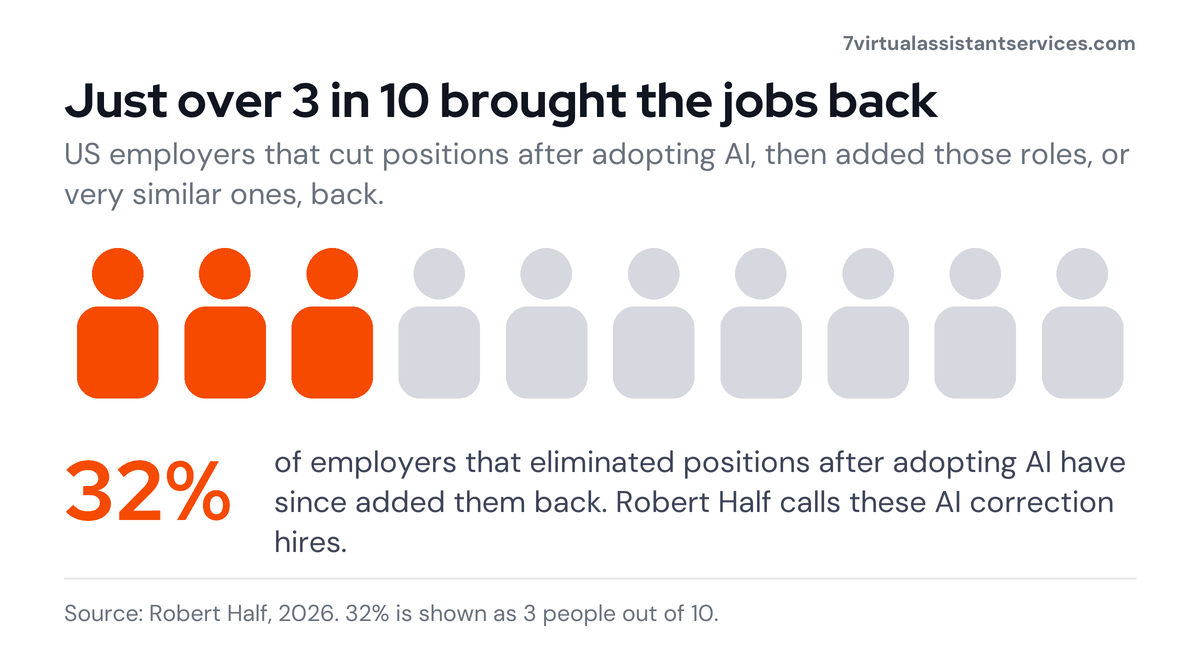
Quick answer: Yes, companies are rehiring after AI layoffs, but it’s a partial reversal, not a stampede. Robert Half found that 32% of US employers that eliminated positions after adopting AI later added those roles back, most often because the work needed more context, relationships or checking than expected. Employers still cited AI in 121,401 announced US job cuts through October 2026. For a small business, the lesson is to automate tasks first and change a role only after AI has proved it can do the work.
A quick disclosure: I run a virtual assistant company, so I have a stake in people still being useful. I’ve also worked as a VA for 16 years and watched AI take real work off the table. So I’ll show you the numbers that cut against my side too.
Are companies really rehiring after AI layoffs?
Yes, some are. But the surveys behind the headlines measure different things, so it’s worth seeing them side by side.
| Source | Who was asked | What they found | What it really tells you |
|---|---|---|---|
| Robert Half | US hiring managers whose organizations cut positions after adopting AI | 32% later added those roles, or very similar ones, back | How often employers reverse the decision |
| SHL | 2,036 employed adults in the US and UK, June and July 2026 | 19% of US workers and 13% of UK workers report firsthand experience of being replaced by AI and asked back | What workers say happened to them |
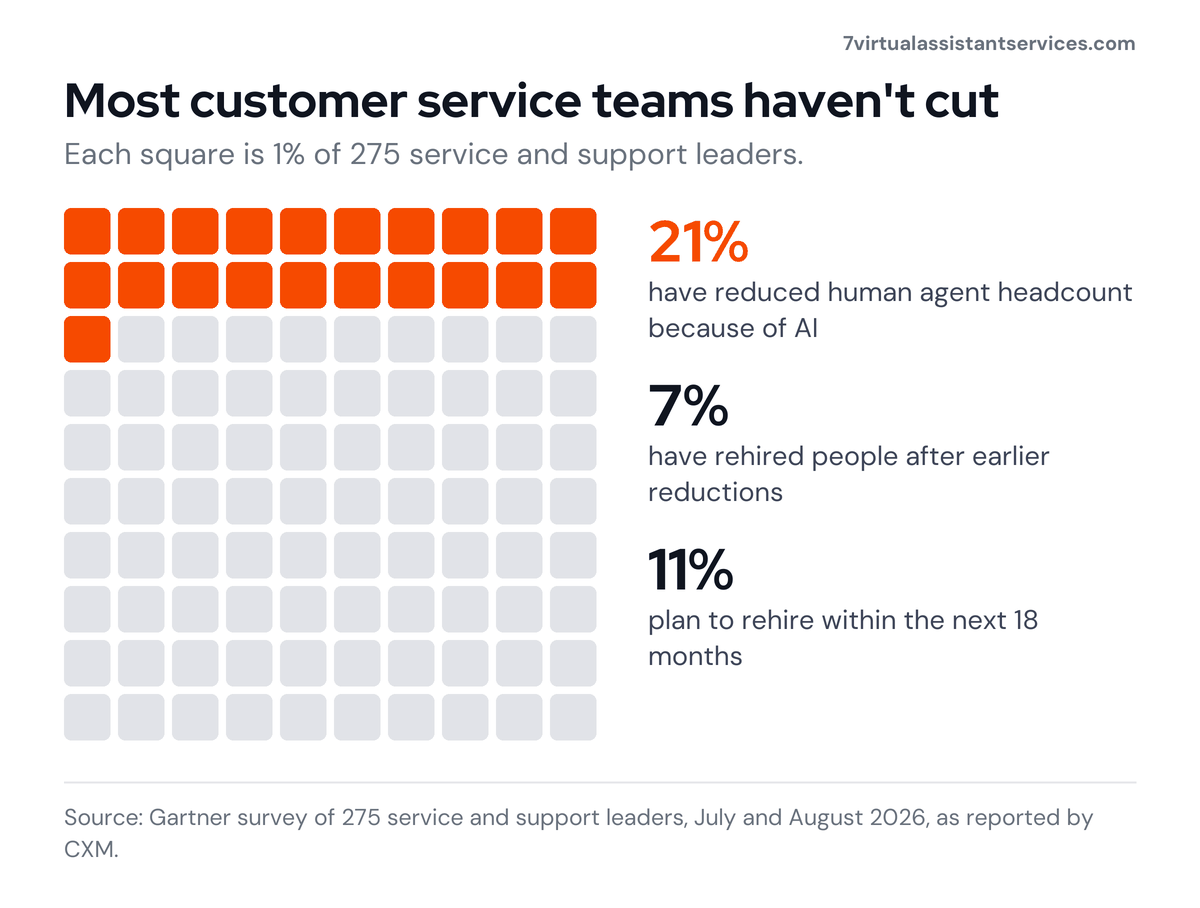
| Gartner | 275 customer service leaders, July and August 2026 | 7% have rehired after earlier cuts, and 11% plan to within 18 months | Customer service only, and still early |
| Forrester | Predictions 2026 report, published October 2025 | 55% of employers regret laying off workers because of AI | Employer sentiment, not actual rehiring |

You may have seen the Fortune headline saying nearly 20% of US workers replaced by AI are being asked back. Read that one carefully.
SHL’s release says nearly one in five US workers report firsthand experience. It doesn’t spell out the base, but it reads as a share of everyone surveyed, not a share of people who lost a job to AI. It’s also self-reported, so it depends on each person’s view of why their job went.
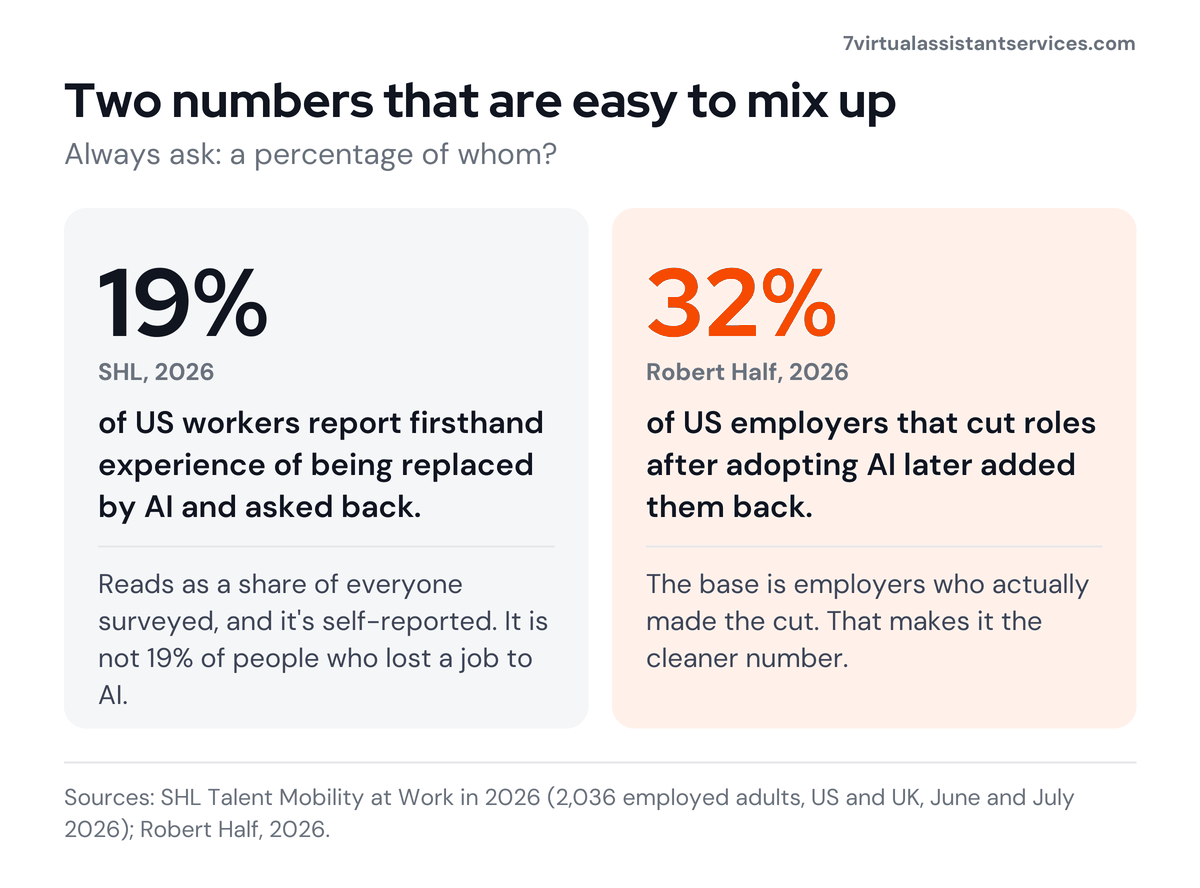
That’s why I lean on Robert Half’s number. It asks the cleanest question: of the employers who actually cut roles, how many put them back? Just over 3 in 10 did. Robert Half has even named them “AI correction hires.”
Why are companies bringing the jobs back?
Because the job was bigger than the task list. Robert Half asked hiring managers why the roles returned, and these were the top reasons:

- 40% needed institutional knowledge AI couldn’t replace. That’s knowing which supplier always bills late, or that your biggest client hates phone calls. Nobody wrote it down because nobody had to.
- 39% involved relationships AI couldn’t replicate. People forgive a mistake from someone they know. They don’t extend that to a chatbot.
- 39% were needed as demand grew. This one is good news, and it isn’t a failure of AI at all.
- 38% needed more oversight and quality control than expected. This is the hidden cost. Somebody has to check the output, and that somebody is usually on the payroll or is you.
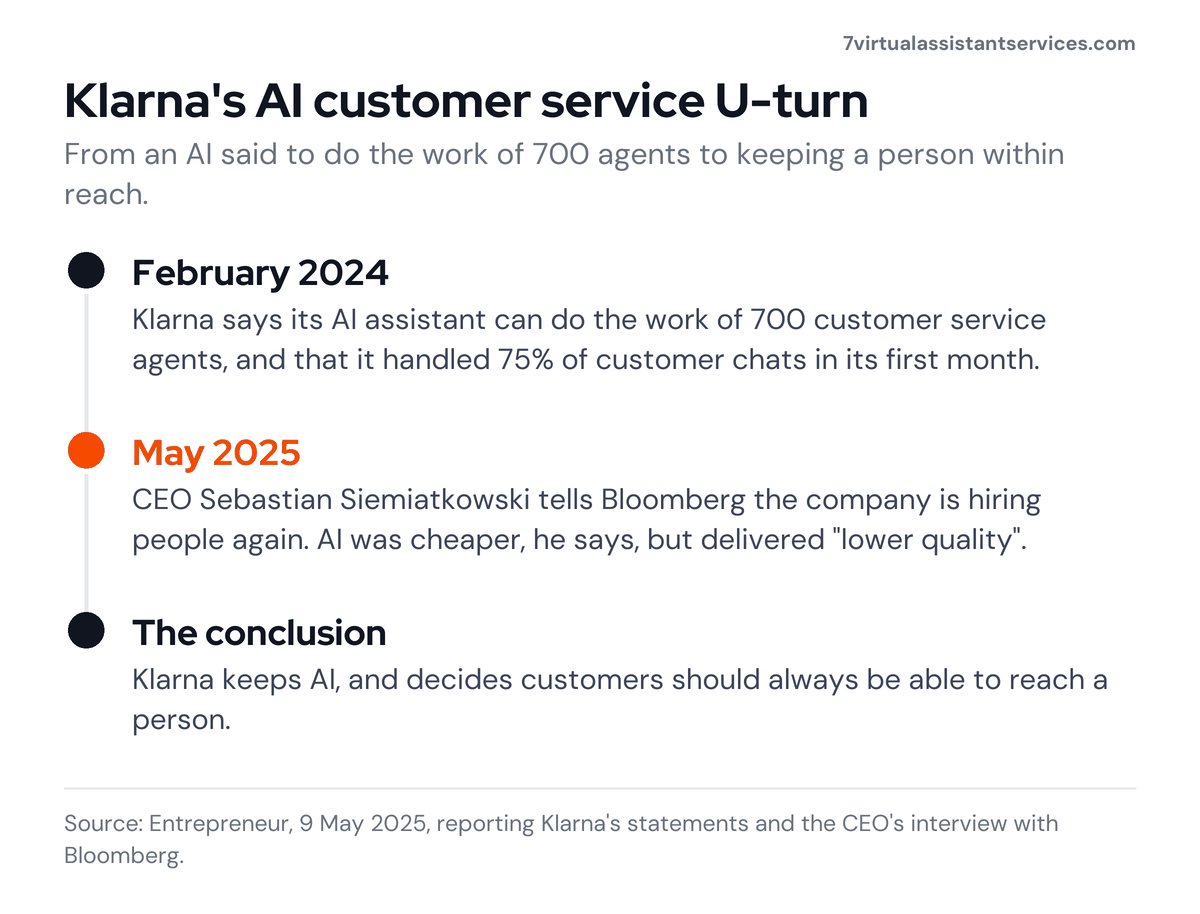
Klarna is the best-known example. In February 2024, the company said its AI assistant could do the work of 700 customer service agents and had handled 75% of customer chats in its first month. By May 2025, CEO Sebastian Siemiatkowski was telling Bloomberg the company was hiring people again. AI was cheaper, he said, but delivered “lower quality.”
Klarna didn’t abandon AI. It decided customers should always be able to reach a person. That’s a much more useful conclusion than “AI failed.”
What does it cost to get this wrong?
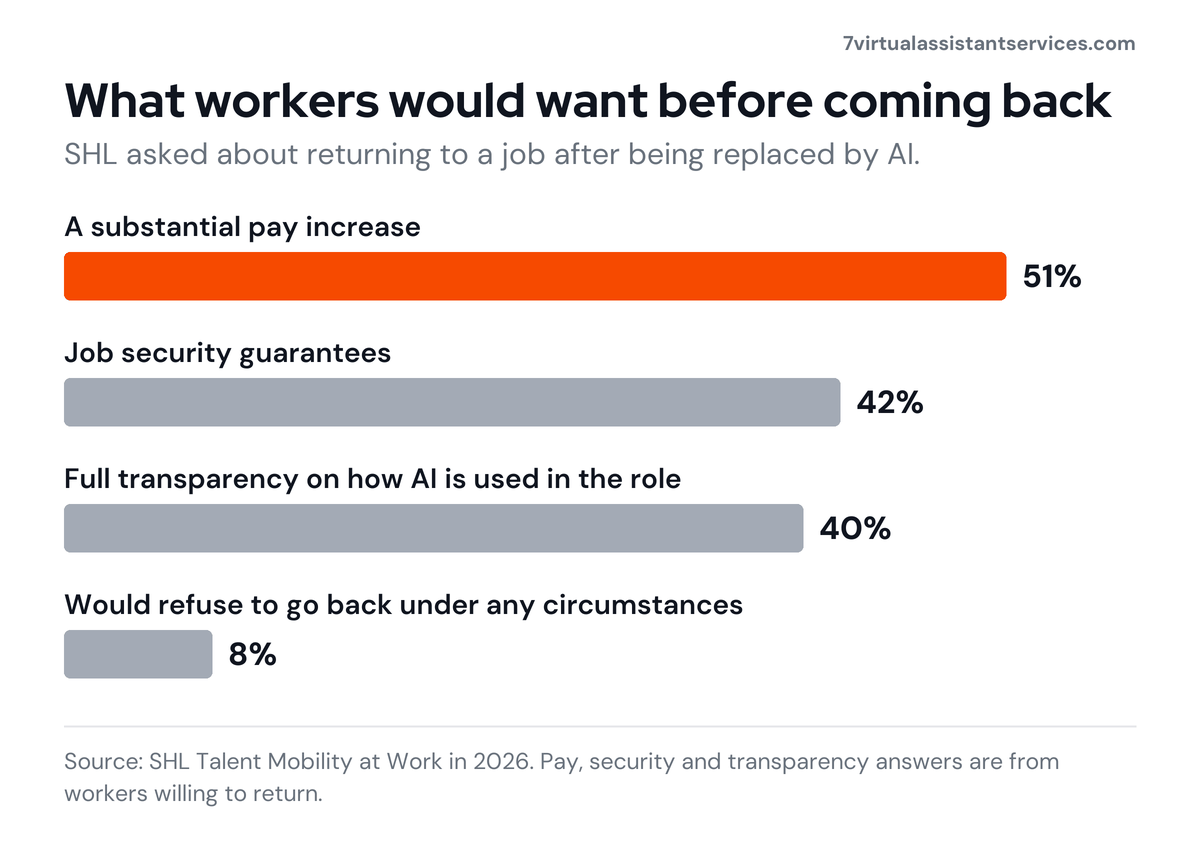
More than the salary you thought you saved. When SHL asked workers about returning after being replaced by AI, here’s what came back:
- 51% would want a substantial pay increase
- 42% would want job security guarantees
- 40% would want full transparency about how AI is used in their role
- 8% would refuse to go back under any circumstances
SHL’s Lucy Beaumont called it “a wake-up call.” In her description, the AI falls short, the gap becomes obvious, and the business rehires the same experts at a higher cost.
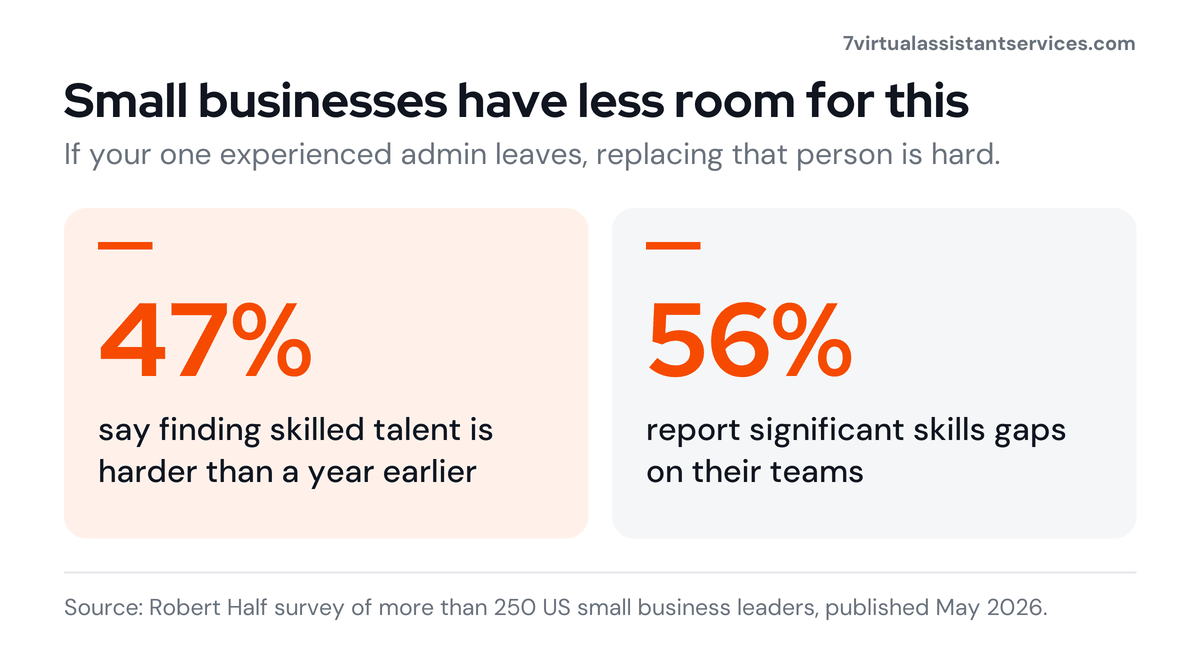
Small businesses have even less room for this. In a Robert Half survey of more than 250 US small business leaders, 47% said finding skilled talent is harder than a year earlier, and 56% reported significant skills gaps. If your one experienced admin leaves, you may not get that person, or that knowledge, back.
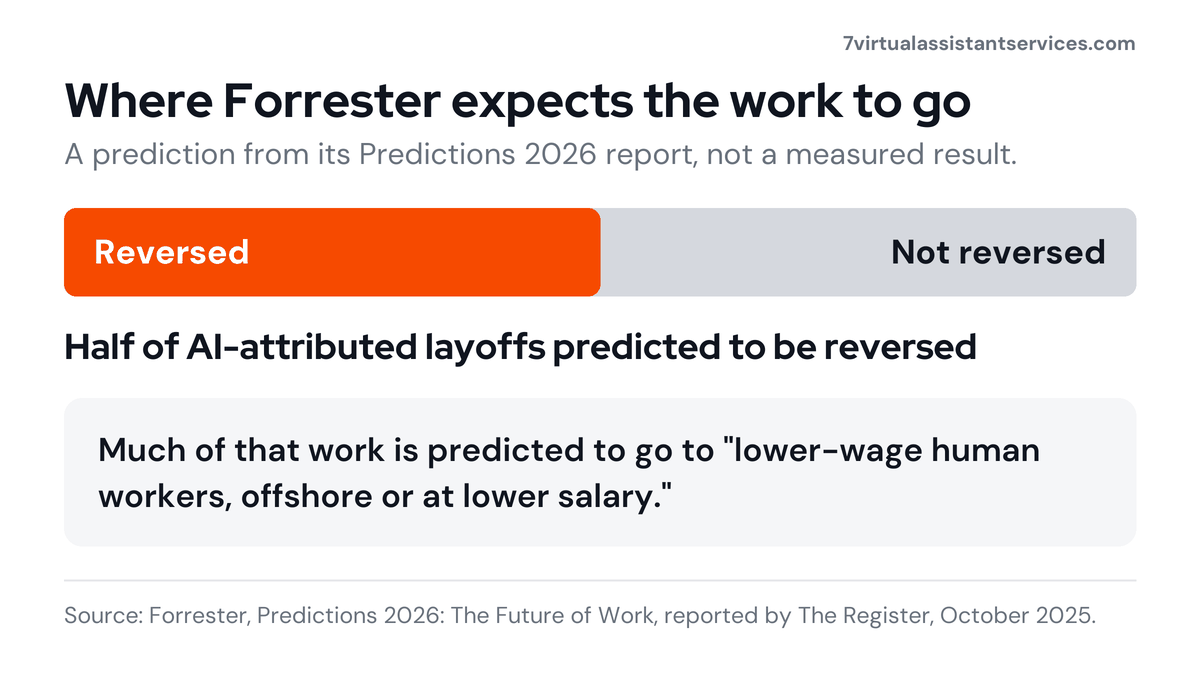
There’s also an uncomfortable twist, and it touches my own industry. Forrester predicts half of AI-attributed layoffs will be reversed, with much of the work going to “lower-wage human workers, offshore or at lower salary.”
Offshore support can be a good decision. I obviously think so. But it should be a decision you make on purpose, with the work properly documented and managed, and not the cleanup after an automation project went wrong.
Is AI still taking jobs?
Yes, and anyone who tells you this is all over isn’t reading the data.
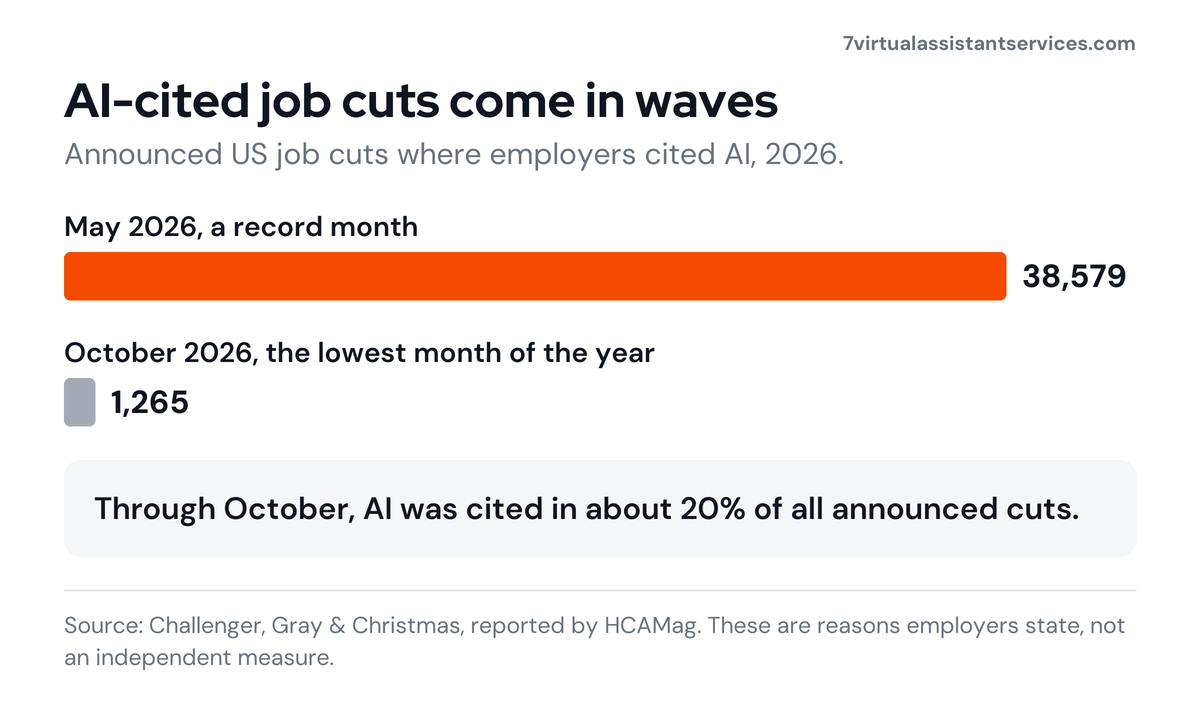
Employers cited AI in 121,401 announced US job cuts through October 2026, according to Challenger, Gray & Christmas. That’s more than double the 54,836 for all of 2025, and about 20% of all announced cuts this year.

Three things to keep in mind before you panic or celebrate:
- It’s what employers say. Challenger counts the reason given in the announcement, and “AI” can sound better to investors than “we overhired.”
- It’s uneven. May 2026 set a record at 38,579 AI-cited cuts. October had just 1,265, the lowest month of the year.
- Most customer service teams haven’t cut. Gartner found only 21% of service leaders had reduced human agent headcount because of AI. Gartner analyst Emily Potosky said “widespread reductions are not yet evident in the data.”
So both things are true. AI is cutting some jobs, and some of those cuts are being undone.
What should a small business learn from AI rehiring?
Replace tasks, not jobs. And don’t change a role until the AI has earned it.
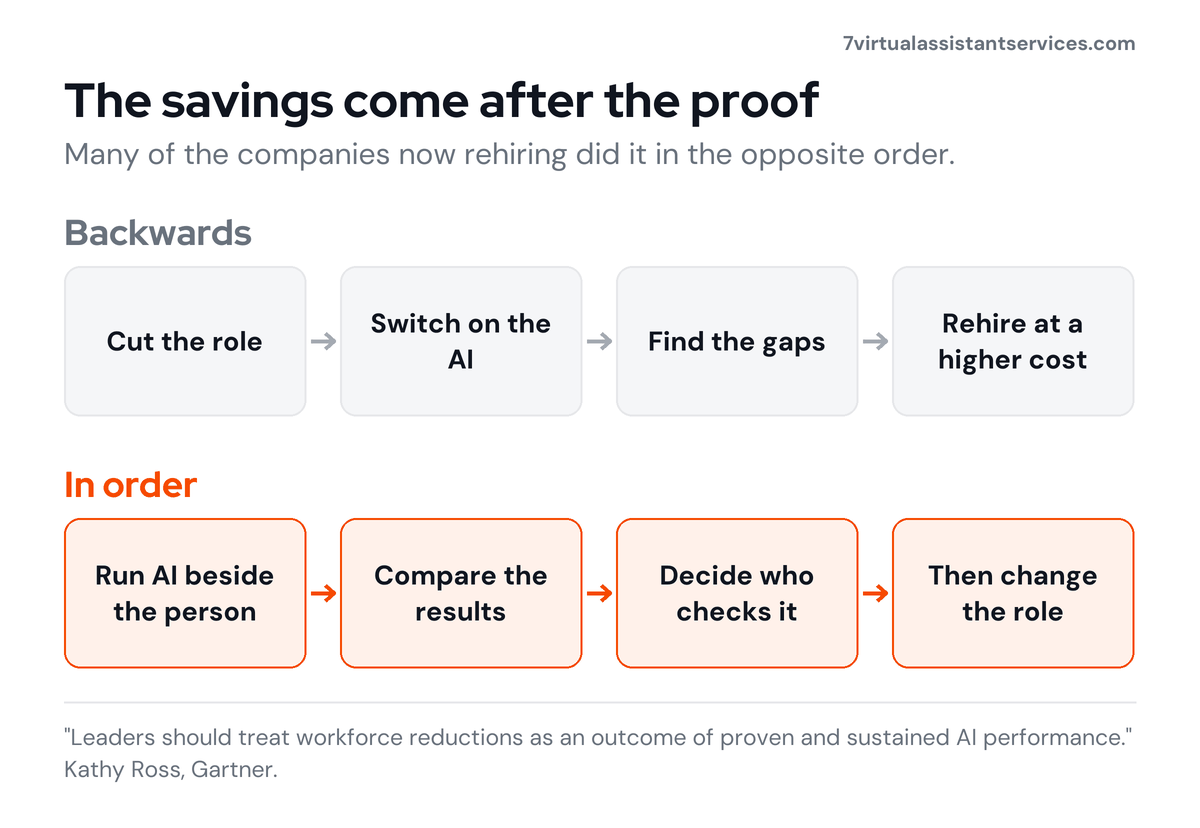
Gartner’s Kathy Ross put it well: “Leaders should treat workforce reductions as an outcome of proven and sustained AI performance.” In other words, the savings come after the proof. Many of the companies now rehiring did it in the opposite order.
Before you take a person out of a role, or skip a hire because “AI can do that,” ask these five questions:
- What does this person know that isn’t written down? If you can’t list it, AI can’t learn it.
- Who would notice if they disappeared? Clients, suppliers and teammates are the real test.
- Who will check the AI’s work, and for how many hours a week? Put a number on it. If the answer is “me,” count your own time.
- What happens when the AI is wrong? A clumsy internal summary is fine. A wrong invoice sent to your biggest client isn’t.
- Has the AI done this work reliably for a few months? Run it alongside the person first and compare the results.

Then sort the work by what a mistake would cost you:
| Type of work | Example | Best setup | Why |
|---|---|---|---|
| Repetitive, low risk | Meeting notes, inbox sorting, common FAQs | AI on its own, with spot checks | Errors are cheap and easy to catch |
| High volume, errors cost money | Invoice entry, CRM updates, data cleanup | AI does it, a person checks it | The speed is real, and so is the risk |
| Exceptions and follow-up | Chasing late payers, rescheduling, missing paperwork | A person using AI | Someone has to own the outcome |
| Relationships | Upset customers, key accounts, renewals | A person | Trust is the job |
| Regulated sign-off | Tax filings, legal advice | A licensed professional | Accountability can’t be delegated to software |

When is replacing a role with AI the right call?
Sometimes it is, and you shouldn’t feel bad about it.
It can make sense if the work is genuinely repetitive, the AI has matched human quality over a real test period, someone is clearly responsible for monitoring it, and customers can still reach a person. It also makes sense to change the shape of a role rather than remove it. Gartner found 71% of service leaders are moving agents into new roles within service and support.

And if a simple tool covers your needs, just use the tool. I went through exactly when that’s enough in will AI replace virtual assistants.
Where does a virtual assistant fit in?
Every AI setup needs an owner. Look again at that 38%: employers needed more oversight than they expected. In a small business with no IT team, that oversight lands on the founder by default.
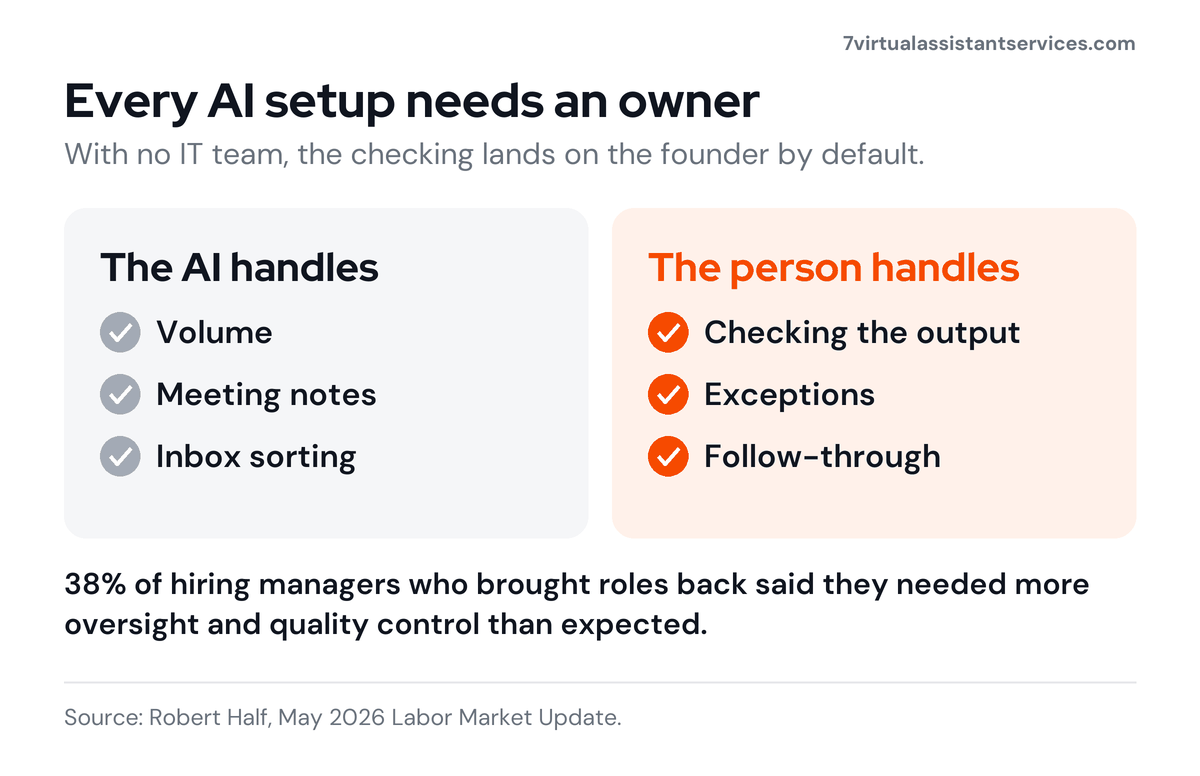
A virtual assistant who works with AI is a practical way to fill that gap. The AI handles volume, and the person handles checking, exceptions and follow-through. You can apply it to customer service, email management, calendar management or bookkeeping.
It also addresses the institutional knowledge problem, if you set it up properly. At 7VAS, every plan includes a dedicated VA, a trained backup VA, a QC reviewer and an account manager, so what your VA learns about your business doesn’t sit with one person.

For cost, 7VAS starts at US$699 a month for 80 hours and US$999 a month for 160 hours on our price plans, month to month. That’s more than an AI subscription and well below a full-time hire. Our virtual assistant cost guide breaks down the wider market, and our statistics page has more data on AI use in small businesses.
Frequently asked questions
Are companies rehiring after AI layoffs?
Yes, some are. Robert Half found that 32% of US employers that eliminated positions after adopting AI later added those roles, or very similar ones, back. In customer service, Gartner found 7% of leaders had rehired after earlier reductions and 11% planned to within 18 months, so the trend is real but still limited.
What is AI rebounding?
AI rebounding is SHL’s term for workers being replaced by AI and later asked to return by the same employer. SHL’s 2026 survey of 2,036 employed adults found 19% of US workers and 13% of UK workers report firsthand experience of it.
What percentage of workers replaced by AI get asked back?
No survey has measured this cleanly. The widely shared figure of nearly 20% comes from SHL, whose release says 19% of US workers report firsthand experience, which reads as a share of all workers surveyed. The clearer employer figure is Robert Half’s: 32% of employers that cut roles after adopting AI added them back.
What are AI correction hires?
AI correction hires is Robert Half’s term for positions an employer eliminated after adopting AI and later had to add back. The most common reasons were institutional knowledge AI couldn’t replace (40%), relationship management (39%), growing business demand (39%) and more oversight than expected (38%).
Why do AI layoffs backfire?
AI layoffs backfire when a company automates a job before understanding everything the job involves. Robert Half’s data points to missing context, lost relationships and more checking than planned. Klarna’s CEO said its AI customer service was cheaper but “lower quality,” and the company began hiring people again in 2025.
How many jobs has AI replaced in 2026?
Nobody has an exact count. Challenger, Gray & Christmas reports that employers cited AI in 121,401 announced US job cuts through October 2026, up from 54,836 in all of 2025. That figure reflects the reasons employers give, so it isn’t an independent measure of jobs AI actually replaced.
Do workers replaced by AI demand more money to come back?
Many say they would. In SHL’s 2026 survey, 51% of workers willing to return would want a substantial pay increase, 42% would want job security guarantees and 40% would want transparency about how AI is used in their role. Another 8% said they would refuse to return under any circumstances.
Should a small business replace staff with AI?
Replace tasks first. AI works well on repetitive, low-risk work, but roles that depend on context, relationships or follow-through are the ones employers most often had to bring back. Test AI alongside the person for a few months and decide who checks its work before you change the role.
The bottom line
AI layoffs aren’t over, and AI isn’t going away. But a meaningful share of the employers who moved fastest have already paid to reverse the decision.
You don’t have to repeat their experiment. Automate the tasks, keep a human in charge of the outcome, and let the results tell you when a role should change.
Not sure which parts of your workload belong with AI and which need a person? Have a look at our virtual assistant services and book a free consultation. Tell us what’s on your plate, and we’ll help you sort it.

John Peter D
John has worked as a virtual assistant for 16 years and founded 7VAS to give small businesses a dedicated VA with the cover and quality checks he wished his own clients had. His team works from Chennai, India, with Philippines-based VAs and bilingual English–Spanish teams in Brazil and Chile, supporting 200+ clients across the US, UK, UAE, Singapore and Australia.