
- Blog
- Trends
- Virtual Assistant Statistics 2027: 100+ Verified Data Points on Cost, Outsourcing, Remote Work and AI
Virtual Assistant Statistics 2027: 100+ Verified Data Points on Cost, Outsourcing, Remote Work and AI


Table of contents
- Key virtual assistant statistics for 2027
The statistics, by topic
- 1. Virtual assistant market size and growth
- 2. The outsourcing market
- 3. English proficiency in outsourcing countries
- 4. Why businesses outsource
- 5. Remote, hybrid and flexible work
- 6. The admin burden on business owners
- 7. Delegation and productivity
- 8. AI and small business
- 9. What an employee really costs (beyond salary)
- 10. Assistant salaries in the US, UK, Australia and Singapore
- 11. Market snapshots
- What these statistics mean for small businesses in 2027
- Frequently asked questions
- How we compiled these statistics
- Cite this page
Quick answer: The human virtual assistant services market is worth about $19.5 billion (2025) and is forecast to reach $55.4 billion by 2035. In the US, an in-house administrative assistant costs about $70,000 a year once benefits are added to the $48,310 median salary, while 66% of small businesses now use AI and 38% of US knowledge workers freelance. Business owners still lose hours every week to admin: UK SME owners spend 11 hours a week on it.
Business owners in the US, UK, UAE, Singapore and Australia face the same problem going into 2027: too much admin, too little time, and hiring that is slow and expensive. This page brings together the most reliable data on virtual assistants, outsourcing, the true cost of staff, remote work, admin burden and AI. We checked every number against its source on 31 October 2026, and we link to the original so you can check it too.
Using this data? You’re welcome to quote any statistic. Please credit 7 Virtual Assistant Services and link to this page.
Key virtual assistant statistics for 2027
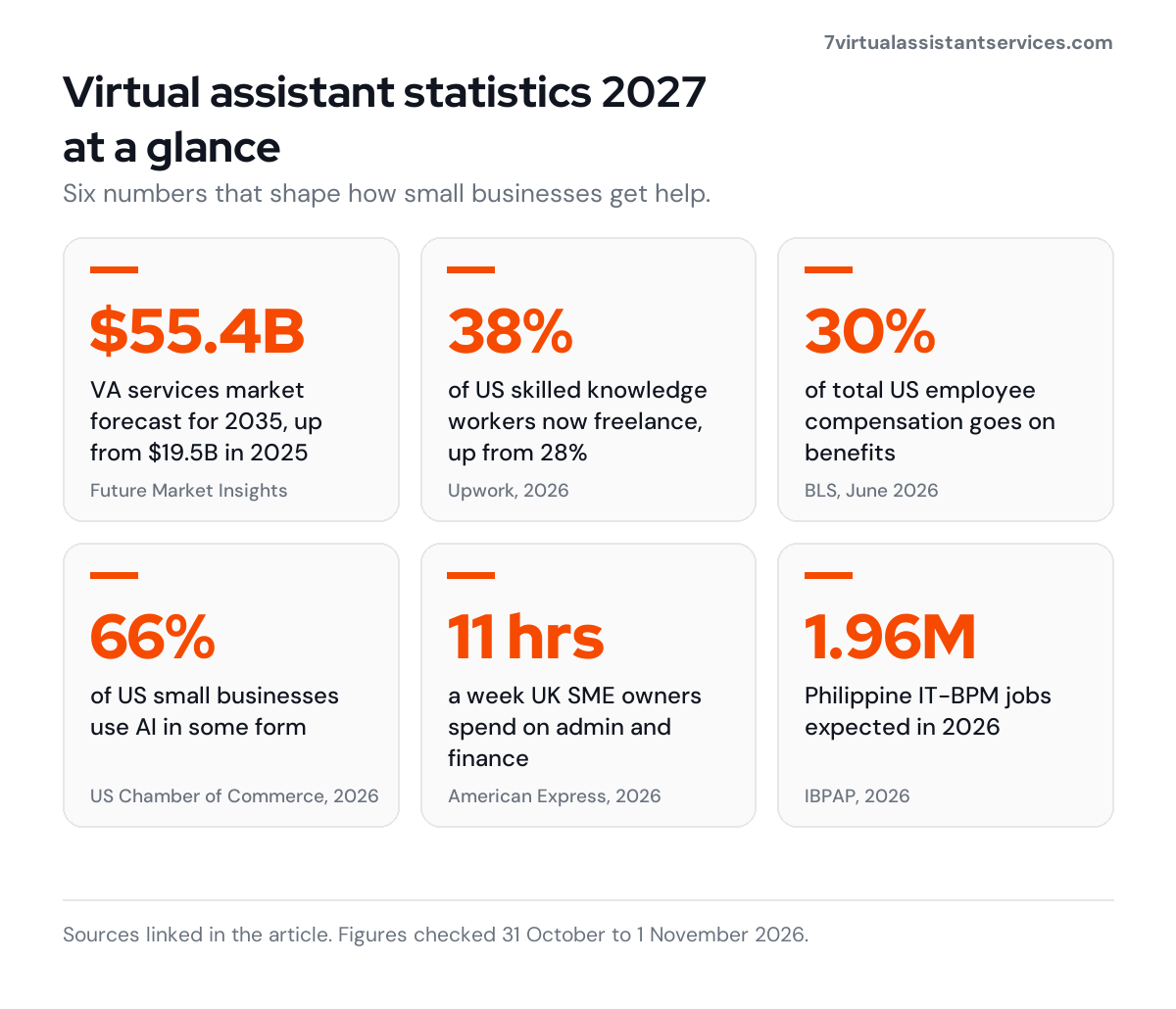
- The global virtual assistant services market is forecast to grow from $19.5 billion in 2025 to $55.4 billion by 2035. (Future Market Insights)
- 38% of US knowledge workers now freelance, up from 28% a year earlier. (Upwork Future Workforce Index 2026)
- US employers pay 30% on top of wages in benefits: $14.07 of every $46.89 an hour. (BLS, June 2026)
- Hiring one non-executive employee costs $5,475 on average and takes a median 39 days. (SHRM)
- 66% of US small businesses use AI, nearly three times the 23% of 2023. (US Chamber of Commerce, 2026)
- UK SME owners spend 11 hours a week on admin, nearly twice the time they spend on growth. (American Express, 2026)
- Workers are interrupted every two minutes, 275 times a day. (Microsoft, 2025)
- 54% of remote-capable US employees work hybrid and 25% fully remote. (Gallup, Aug 2026)
- The Philippine IT-BPM industry expects $42.3 billion in revenue and 1.96 million jobs in 2026. (IBPAP via Philstar)
- 80% of executives plan to keep or increase their outsourcing investment. (Deloitte)
1. Virtual assistant market size and growth
Let’s start with the big picture. How big is the virtual assistant industry, and who’s actually buying? Here’s what the research firms and labour statisticians say. (For our view on where it’s heading next, read the future of the global virtual assistant market.)
- The global virtual assistant services market was valued at $19.5 billion in 2025 and is forecast to reach $55.4 billion by 2035, an 11.0% annual growth rate. (Future Market Insights, 2025)
- Administrative VAs are the largest service type, with 38.4% of the market. (Future Market Insights)
- Small and midsize businesses are the largest client group, at 44.4% of demand. (Future Market Insights)
- Dedicated monthly VA arrangements make up 53.5% of the market, more than ad-hoc or per-task models. (Future Market Insights)
- The AI virtual assistant software market, a separate market from human VA services, is forecast to grow from $8.11 billion in 2025 to $23.97 billion by 2030 (24.1% a year). (The Business Research Company, 2026)
- There are 154 to 435 million online gig workers worldwide, 4.4% to 12% of the global labour force. (World Bank, 2023)
- 38% of US skilled knowledge workers now freelance, up from 28% a year earlier. (Upwork Future Workforce Index, July 2026)
- 58% of US full-time employees are considering freelancing, up from 36% a year earlier. (Upwork, 2026)
- The US has about 3.5 million secretaries and administrative assistants. Employment is projected to fall 2% by 2035, yet about 314,400 openings are still expected each year. (BLS)
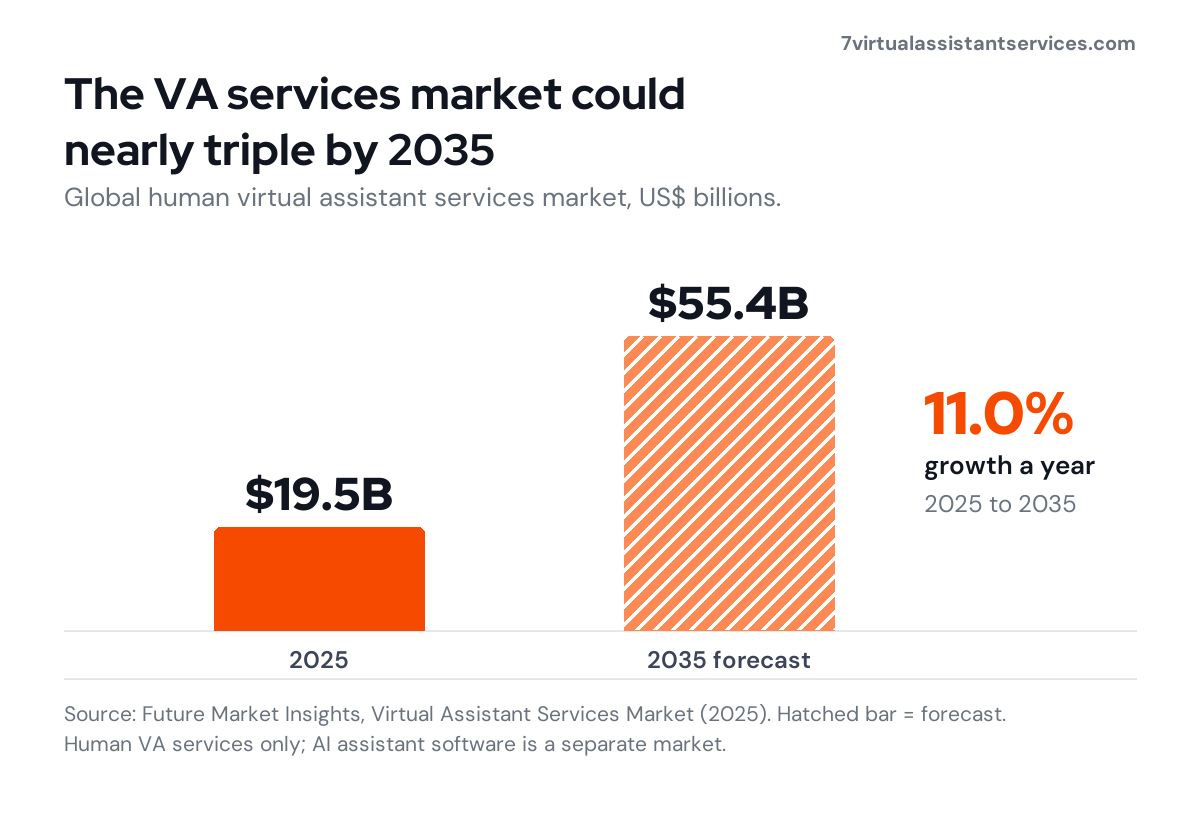
Note: “Virtual assistant” market reports measure different things. Stats 1–4 cover human VA services. Stat 5 covers AI software assistants.
2. The outsourcing market: global, India and the Philippines
Most virtual assistants who work for US, UK and Australian businesses are based in India or the Philippines. Here’s how big those two outsourcing hubs have become. If you’re weighing the two, see what it’s like to work with a VA in India or a VA in the Philippines.
- The global business process outsourcing (BPO) market is valued at $328 billion to $406 billion in 2025, depending on the research firm. (Grand View Research, Precedence Research, Mordor Intelligence)
- Forecasts for BPO range from $624 billion by 2031 (Mordor) and $742 billion by 2034 (Fortune Business Insights) to $906 billion by 2035 (Precedence Research). (Fortune Business Insights)
- North America is the largest buyer of outsourced business processes, with 36% of the market. (Precedence Research)
- Customer service is the largest BPO service type, with 33% of revenue. (Precedence Research)
- Outsourcing by small and medium businesses is growing at 7.56% a year through 2031. (Mordor Intelligence)
- India’s tech industry is estimated at $315 billion in FY26, up 6.1%, including $246 billion in exports. (Nasscom Strategic Review 2026)
- India’s business process management (BPM) segment earns $59 billion in FY26. (Nasscom, 2026)
- India’s tech industry directly employs 5.95 million people in FY26. (Nasscom via ETV Bharat)
- India hosts 2,117 global capability centres with 2.36 million employees and $98.4 billion in revenue. (Zinnov–Nasscom, 2026)
- India’s higher-education enrolment reached 45 million in 2023–24, up 31.5% since 2014–15. (Ministry of Education AISHE, via Careers360)
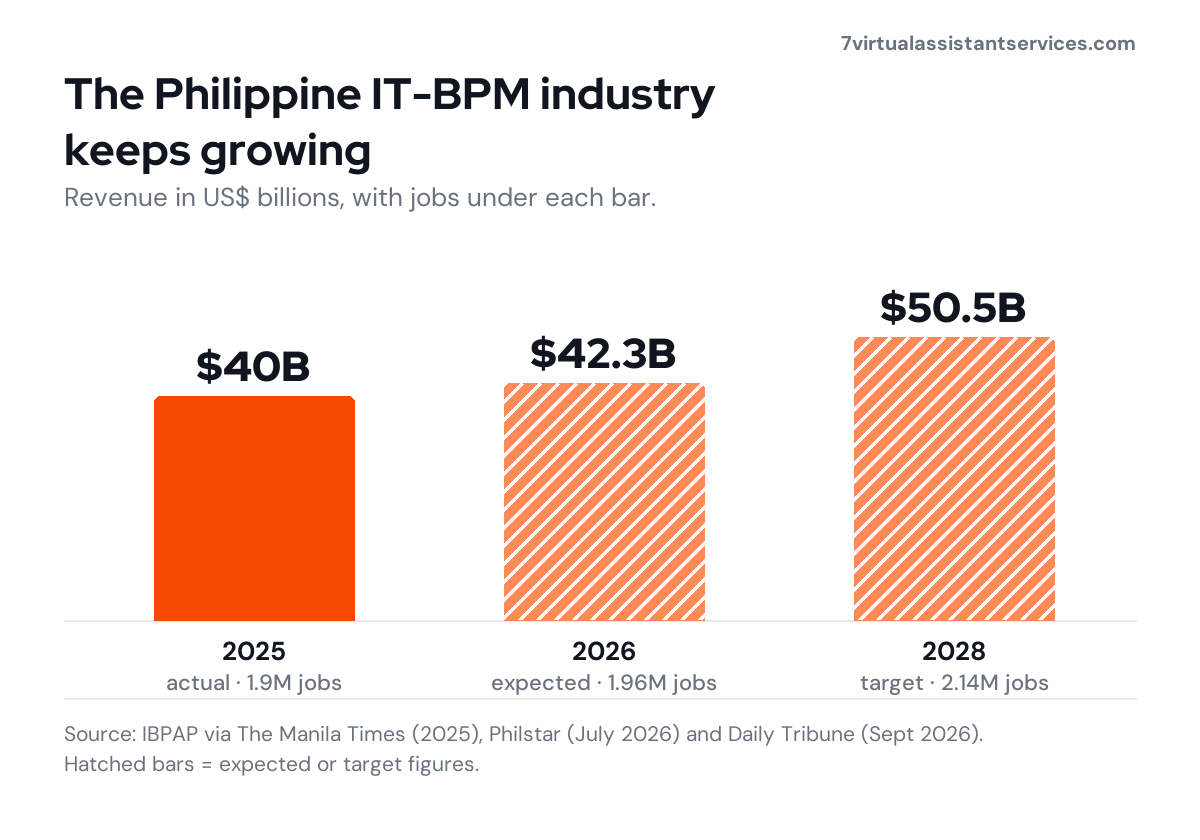
- The Philippine IT-BPM industry earned $40 billion in 2025 and employed 1.9 million people. (IBPAP via The Manila Times)
- IBPAP expects $42.3 billion in revenue and 1.96 million jobs in 2026. (IBPAP via Philstar, July 2026)
- The Philippine industry is targeting up to $50.5 billion and 2.14 million jobs by 2028. (IBPAP via Daily Tribune, Sept 2026)
3. English proficiency in outsourcing countries
Language is usually the first thing business owners ask about when they hire offshore. Here’s how the main outsourcing countries rank.
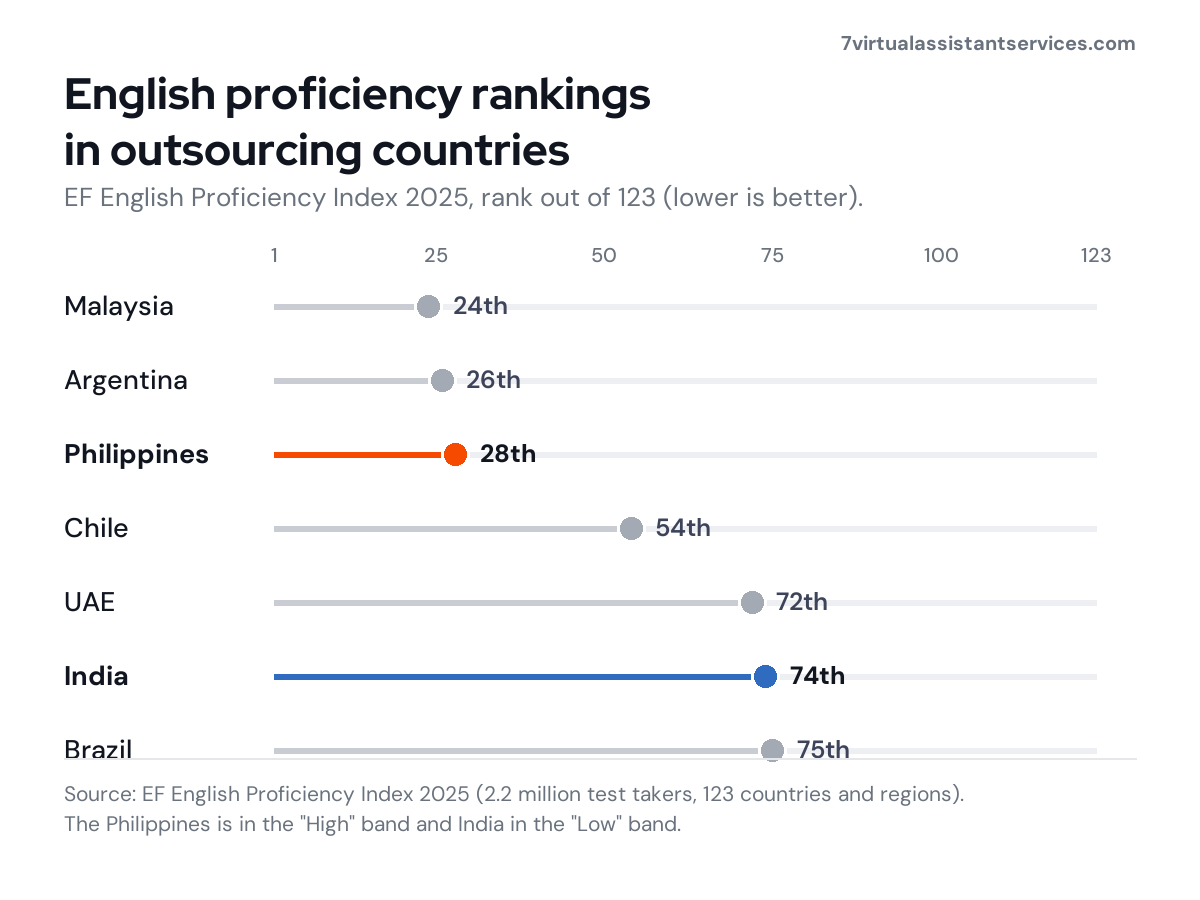
- The EF English Proficiency Index 2025 ranks 123 countries and regions, based on tests taken by 2.2 million adults. (EF EPI 2025)
- The Philippines ranks 28th of 123, in the “High” proficiency band, and second in Asia. (EF EPI 2025)
- India ranks 74th, in the “Low” band. (EF EPI 2025)
- In Latin America, Argentina ranks 26th (High), Chile 54th (Moderate) and Brazil 75th (Low). (EF EPI 2025 report)
- Malaysia ranks 24th, the highest in Asia, and the UAE 72nd. (EF EPI 2025 report)
What this means: national averages don’t describe the people a VA company hires. Country rankings are a reason to test every candidate’s written and spoken English, which is what good VA companies do, rather than to assume it.
Need someone who also speaks Spanish, Arabic or Mandarin? Our bilingual virtual assistants work in English and a second language.
4. Why businesses outsource
Why do companies outsource in the first place? The answer has changed a lot in just a few years, and it isn’t mainly about cost any more.
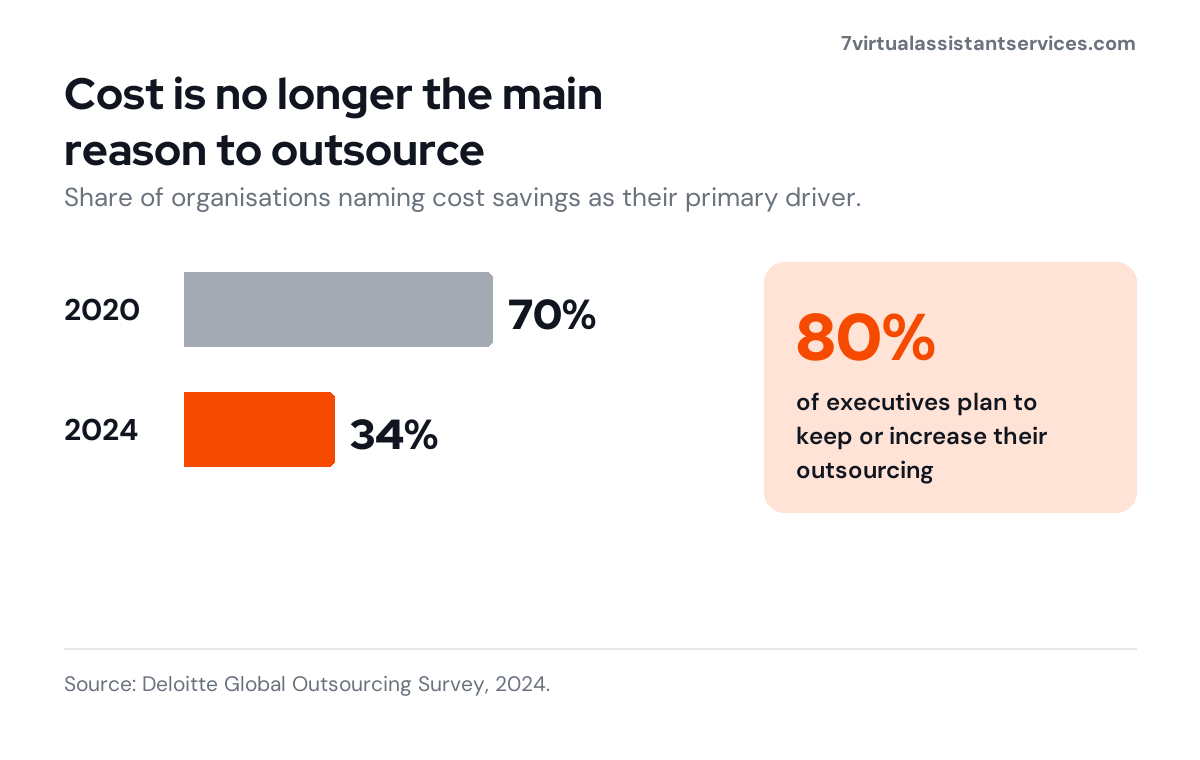
- 80% of executives plan to maintain or increase investment in third-party outsourcing. (Deloitte Global Outsourcing Survey, 2024)
- Cost is no longer the main reason. Organisations citing cost savings as the primary driver fell from 70% in 2020 to 34% in 2024. (Deloitte, 2024)
- 67% of executives use outcome-based outsourcing relationships. (Deloitte, 2024)
- 50% of executives outsource front-office work such as sales, marketing and R&D. (Deloitte, 2024)
- 70% have selectively brought some outsourced scope back in-house, which shows that choosing the right partner matters. (Deloitte, 2024)
- 83% of executives expect outsourcing vendors to bring AI capabilities. (Deloitte, 2024)
- 31% of US small and midsize business leaders relied on flexible talent to get specialised skills. (Upwork Research Institute, 2025)
- Medical administrative assistants were among the fastest-growing cross-border hires in 2025, up 123% on Deel’s platform. (Deel State of Global Hiring, 2026)
- 59% of US small business owners adopted new technology, mainly to simplify tasks (62%) and save time (59%). (Slack/Salesforce, 2024)
Wondering what you could hand off first? Here’s what virtual assistant services you can outsource, and the key benefits of hiring a virtual assistant.
5. Remote, hybrid and flexible work
Remote work used to be the exception. Now a large share of the workforce works this way, so working with a remote assistant feels normal for most teams.
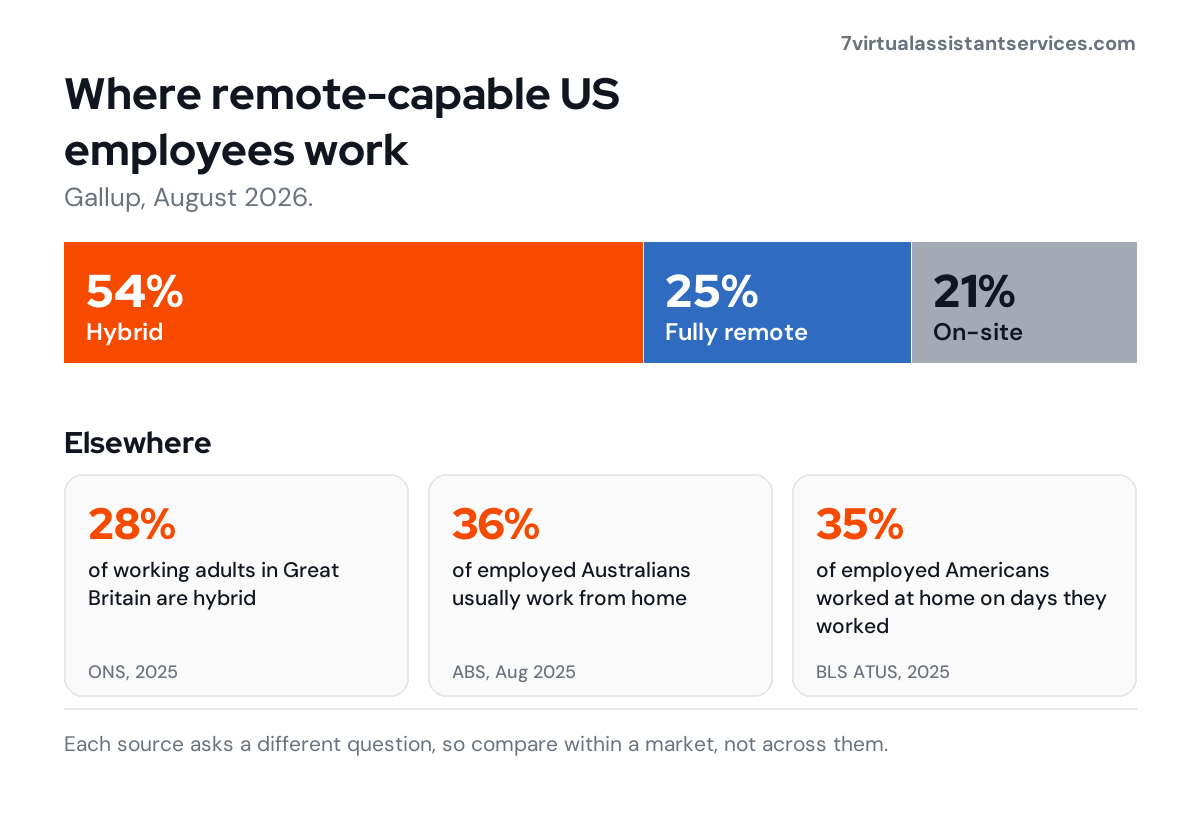
- Among US employees with remote-capable jobs, 54% work hybrid, 25% fully remote and 21% on-site (August 2026). (Gallup)
- Only 6% of remote-capable US employees would choose to be fully on-site, while 61% prefer hybrid. (Gallup)
- 35% of employed Americans did some or all of their work at home on days they worked in 2025. (BLS American Time Use Survey)
- 28% of working adults in Great Britain are hybrid workers. (ONS, 2025)
- 36% of employed Australians usually work from home, including 59% of managers and professionals. (ABS, Aug 2025)
- 69% of managers say hybrid and remote work have made their teams more productive. (Owl Labs, 2026)
- Nearly a third of meetings now span multiple time zones. (Microsoft, 2025)
6. The admin burden on business owners
If you run a small business, this section will feel familiar. Admin eats the hours you’d rather spend on customers and growth.
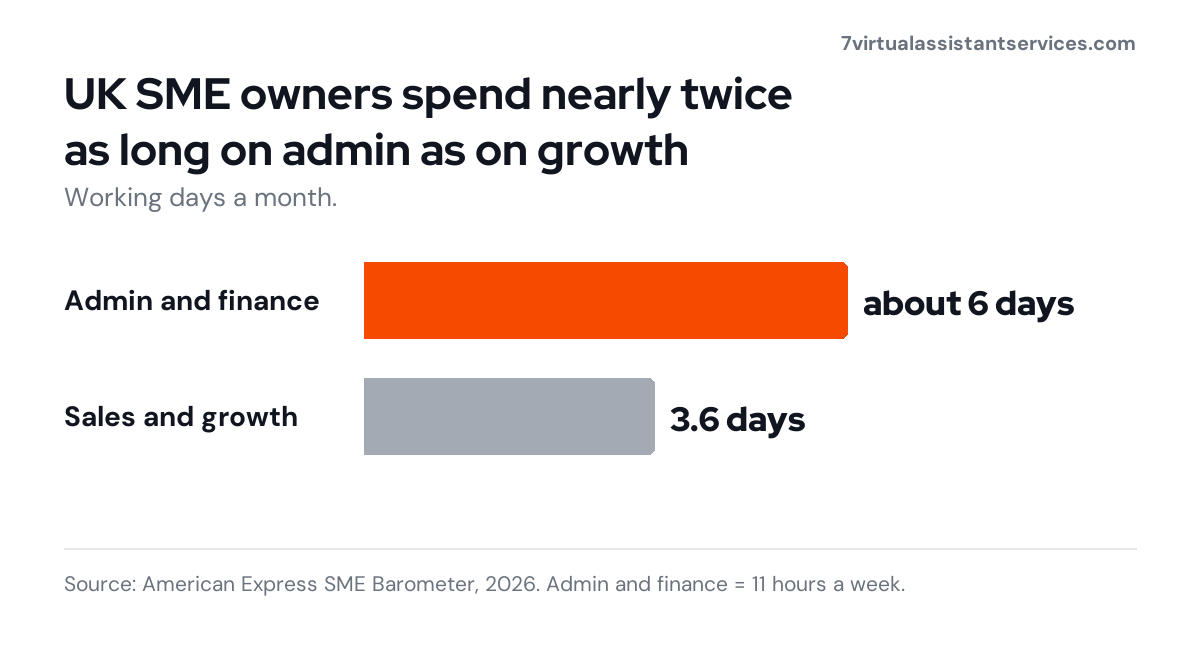
- UK SME owners spend 11 hours a week (about six working days a month) on admin and finance, but only 3.6 days a month on sales and growth. (American Express SME Barometer, 2026)
- 54% of UK SME owners say paperwork gets in the way of running their business. (American Express, 2026)
- 36% of UK SME owners say their own lack of capacity is the biggest barrier to growth, and 20% work 60+ hours a week. (American Express, 2026)
- UK small firms spend £36 billion and 379 million hours a year on red tape. (Federation of Small Businesses, 2026)
- Each UK small firm spends about £4,500 and 44 hours a year on tax compliance. (FSB via Accountancy Age, 2025)
- US small business owners lose 96 minutes of productivity a day, about three weeks a year. (Slack/Salesforce, 2024)
- US small business owners lose 33 working days a year to tax and financial stress. (Xero via CPA Practice Advisor, 2026)
- Knowledge workers spend 58% of their day on “work about work” such as status updates, searching and chasing approvals. (Asana, 2023)
- Workers are interrupted every two minutes, 275 times a day. (Microsoft, 2025)
- The typical worker receives 117 emails and about 153 Teams messages a day. (Microsoft, 2025)
- 80% of employees and leaders say they lack the time or energy to do their work. (Microsoft Work Trend Index, 2025)
- 68% of workers say they don’t get enough uninterrupted focus time. (Microsoft, 2023)
- Teams waste 25% of their time searching for answers. (Atlassian State of Teams, 2025)
Much of this is inbox, calendar and paperwork. A virtual administrative assistant can take on email management, calendar management and data entry, and a bookkeeping or accounting virtual assistant can handle the books while your accountant still reviews and files.
7. Delegation and productivity
Delegating well is one of the highest-leverage habits an owner can build. Here’s what the research says about delegation, time and output. (We also wrote about why smart CEOs hire virtual assistants instead of full-time staff.)
- CEOs who delegate well grew 112 percentage points faster over three years than weak delegators. (Gallup, 2015)
- Knowledge workers say better processes would save them 4.9 hours a week. Unnecessary meetings cost them 2.8 hours a week, and senior leaders 3.6. (Asana, 2023)
- In Australia’s government Copilot trial, users reported saving around an hour a day on summarising, first drafts and searching. (Digital Transformation Agency, 2024)
- Among UK SME owners who want to delegate, 33% would use AI for general admin and 23% for finance. (American Express, 2026)
- An AI assistant raised customer-support productivity by 14% on average and by 34% for newer workers. (NBER, 2023)
- Workers using generative AI saved 5.4% of their hours, about 2.2 hours a week. (Federal Reserve Bank of St. Louis, 2025)
- Consultants using GPT-4 finished over 12% more tasks, over 25% faster, with over 40% higher human-rated quality. (Harvard Business School & BCG, 2023)
Already have a VA but not seeing the results you hoped for? Here’s how to get more output from your virtual assistant.
8. AI and small business
AI comes up in almost every conversation about hiring help right now. Will it replace virtual assistants? The data paints a more nuanced picture than the headlines.
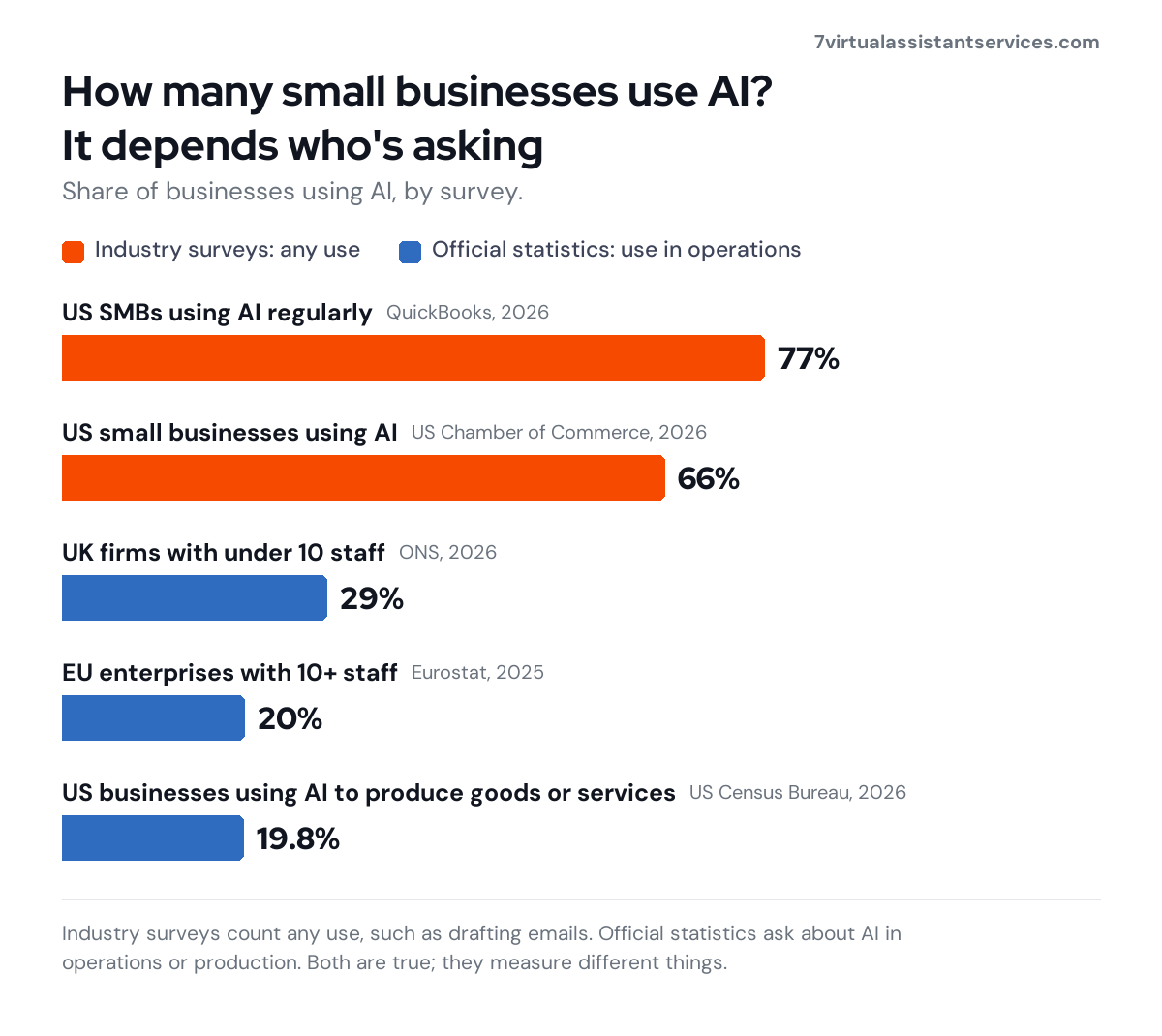
- 66% of US small businesses use AI, up 8 points from 2025 and nearly three times the 23% of 2023. (US Chamber of Commerce, Oct 2026)
- 77% of US small and mid-sized businesses use AI regularly, up from 48% in July 2024, and 78% say it has improved productivity. (Intuit QuickBooks AI Impact Report, 2026)
- Only 19.8% of US businesses use AI to produce their goods or services, and fewer than 20% of firms with four or fewer employees, compared with 37% of firms with 250+ staff. (US Census Bureau, May 2026)
- 30% of UK businesses use at least one AI technology, and 29% of those with fewer than 10 employees. (ONS, Oct 2026)
- 20% of EU enterprises with 10+ employees used AI in 2025, up from 13.5% in 2024. (Eurostat, 2025)
Why the AI numbers differ: the Census Bureau and ONS ask whether a business uses AI to produce its goods or services. The US Chamber and QuickBooks surveys count any use, such as drafting emails. Both are true; they measure different things.
- Nearly nine in ten respondents say their organisation regularly uses AI in at least one business function. (McKinsey State of AI, 2026)
- 80% say AI has improved their individual productivity. (McKinsey, 2026)
- 66% of knowledge workers who use AI say it lets them spend more time on high-value work, and 58% produce work they couldn’t a year ago. (Microsoft Work Trend Index, 2026)
- 75% of knowledge workers use AI at work, and 78% of them bring their own tools. (Microsoft & LinkedIn, 2024)
- 76% of workers are comfortable using AI for administrative tasks. (Microsoft, 2023)
- 82% of leaders plan to use “digital labour” to expand workforce capacity within 12–18 months. (Microsoft, 2025)
- Gartner predicts over 40% of agentic AI projects will be cancelled by the end of 2027, and that by 2028 at least 15% of day-to-day work decisions will be made autonomously by agentic AI. (Gartner via Reuters, 2025)
- By 2030, 170 million jobs will be created and 92 million displaced worldwide, and administrative assistants remain among the fastest-declining roles. (World Economic Forum, 2025)
What this means: AI is taking over individual tasks, but most small businesses still lack the time to set it up and someone to own the result. The assistants who do well in 2027 use AI tools to deliver more for each client.
That’s also why many businesses pair an AI phone line with a person: an AI tool takes simple calls, and a customer service virtual assistant handles everything that needs judgement.
9. What an employee really costs (beyond salary)
Salary is only the starting point. Here’s what else employers pay on top of wages in each of the markets we serve.
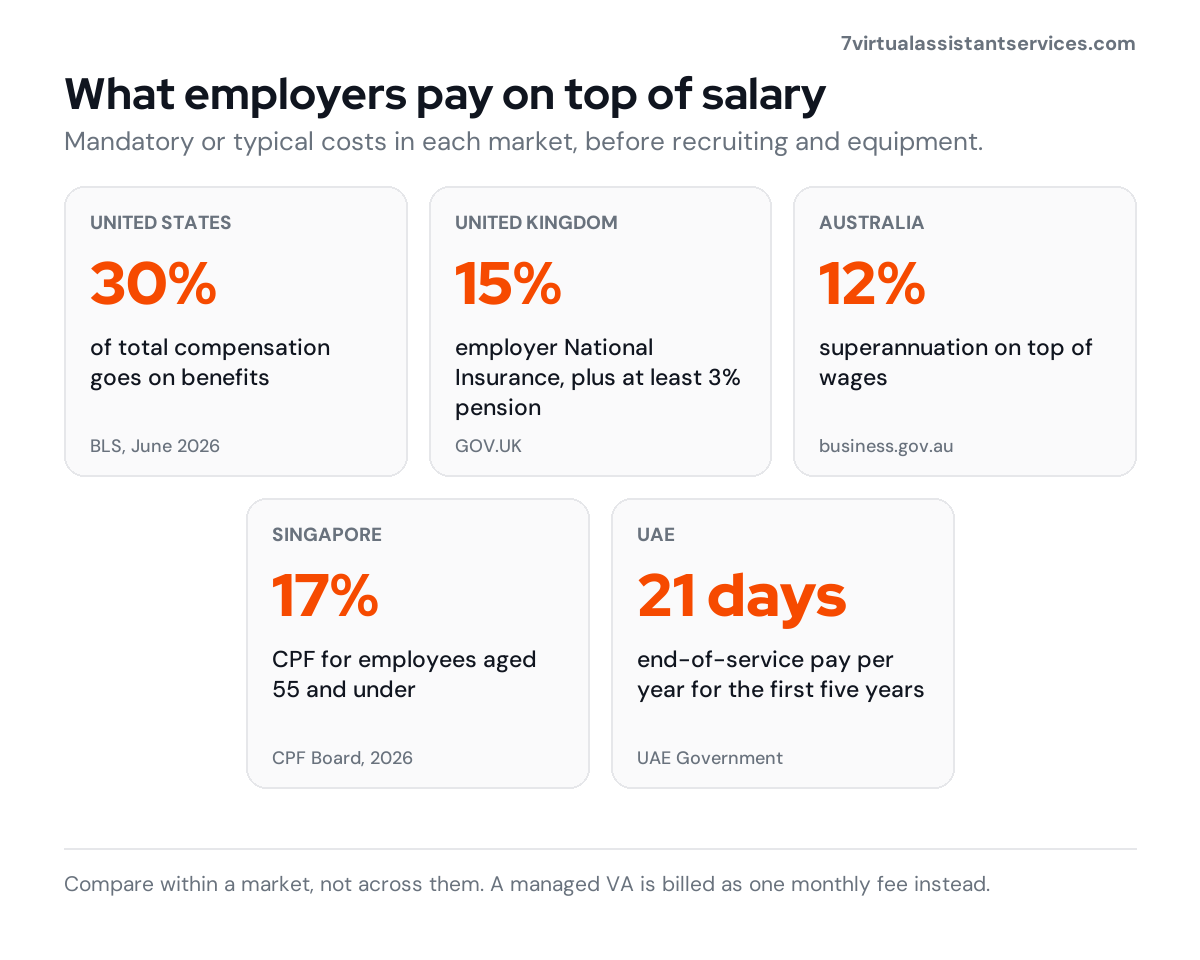
- US private employers pay $46.89 an hour in total compensation, of which $14.07 (30%) is benefits. (BLS Employer Costs for Employee Compensation, June 2026)
- For office and administrative support workers, employers pay $36.73 an hour: $25.22 in wages plus $11.51 in benefits (31.3%). (BLS ECEC, Table 4)
- The average cost per hire is $5,475 for non-executive roles and $35,879 for executives. (SHRM, 2025)
- The median time to fill a non-executive role is 39 days. (SHRM, 2026)
- UK employer National Insurance rose from 13.8% to 15% on 6 April 2025, and the threshold fell from £9,100 to £5,000 a year. The rate is unchanged for 2026/27. (GOV.UK)
- UK employers must pay at least 3% of qualifying earnings into a workplace pension. (GOV.UK)
- Australian employers pay 12% superannuation on top of wages. (business.gov.au)
- Singapore employers pay 17% of wages into CPF for employees aged 55 and under, from 1 January 2026. (CPF Board)
- UAE private-sector employers owe an end-of-service gratuity of 21 days’ pay for each of the first five years, then 30 days a year. (UAE Government portal)
With a managed VA, these costs are part of one monthly fee. You can compare it with our VA pricing.
10. Assistant salaries in the US, UK, Australia and Singapore
How much do in-house assistants earn in each market? Here are the latest official and recruiter figures, so you can compare them with a virtual personal assistant.
- US secretaries and administrative assistants earn a median of $48,310 a year ($23.23 an hour). (BLS, May 2025)
- US executive assistants earn a median of $76,590 a year. (BLS, May 2025)
- Robert Half’s 2027 guide puts the US executive assistant mid-point salary at $73,000 and the administrative assistant mid-point at $52,000. (Robert Half, 2027 Salary Guide)
- UK full-time employees earned a median of £40,911 in April 2026, up 4.5%. (ONS ASHE, Oct 2026)
- The median UK executive assistant salary is £47,000 (£37,500–£53,750). (Robert Half UK, 2027 Salary Guide)
- Australian personal assistants have median weekly earnings of A$1,832, about A$95,000 a year (our calculation). (Jobs and Skills Australia)
- The median Australian executive assistant starting salary is A$115,000, before super. (Robert Half Australia, 2026)
- Singapore executive secretaries earn a median gross wage of S$5,500 a month, against S$4,480 for secretaries. (Ministry of Manpower, Occupational Wages 2025)
- The median Singapore executive assistant starting salary is S$110,000 a year in senior placements. (Robert Half Singapore, 2026)
In-house assistant vs a virtual assistant: the real cost (our calculation)
Salary is only part of the cost of an employee. Using the BLS ratio for office and administrative support workers ($36.73 total cost for every $25.22 in wages, stat 79), here is what a US in-house assistant costs compared with a full-time dedicated VA from 7VAS ($999 a month, $11,988 a year, for 160 hours a month).
| Role | Median salary | Salary + benefits (our estimate) | 7VAS full-time VA | Saving vs salary + benefits |
|---|---|---|---|---|
| US administrative assistant | $48,310 | ~$70,358 | $11,988 | ~83% |
| US executive assistant | $76,590 | ~$111,544 | $11,988 | ~89% |
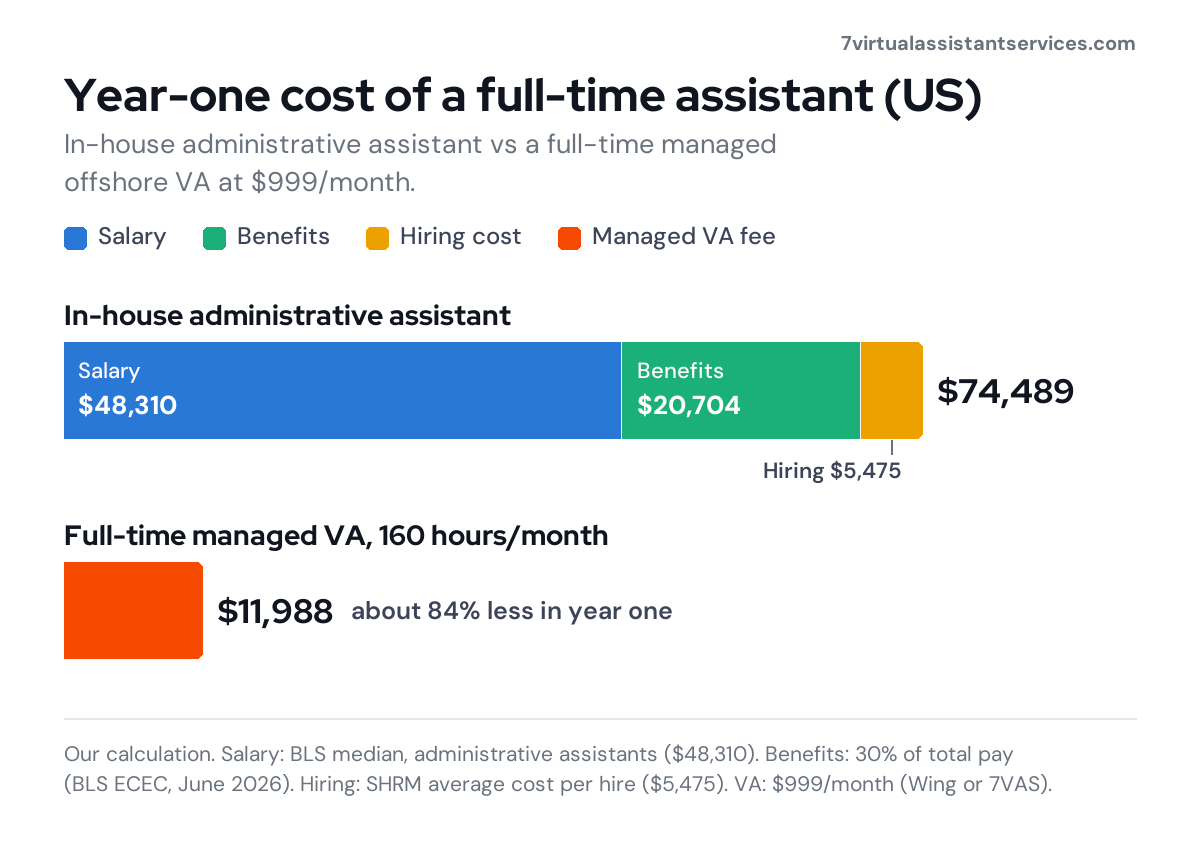
Our calculation: median salary (BLS, stats 87–88) × 1.456 (the BLS total-compensation-to-wage ratio for office and admin support). It doesn’t include recruiting ($5,475 per hire, stat 80), equipment, office space or management time, so the real gap is larger. A VA works remotely and doesn’t replace every in-house role.
Want the numbers for your own business? See 7VAS plans and pricing, with hours and support included.
11. Market snapshots: US, UK, UAE, Singapore and Australia
Finally, a quick snapshot of the five markets we work in. For local prices and time zones, see our virtual assistant pages for the US, UK, UAE, Singapore and Australia.
United States
- There are 36.2 million small businesses, 99.9% of all firms, employing 62.3 million people. (SBA Office of Advocacy, 2026)
- 32% of small business owners had job openings they couldn’t fill, and 51% reported few or no qualified applicants. (NFIB, June 2026)
United Kingdom
- SMEs make up 99.85% of UK private-sector businesses and employ 16.9 million people. (Department for Business and Trade, 2025)
- UK job vacancies fell to 691,000 in July–September 2026. (ONS, Oct 2026)
UAE and Dubai
- The UAE had 557,000 SMEs at the end of 2022, accounting for 63.5% of non-oil GDP, with a target of 1 million by 2030. (UAE Ministry of Economy via WAM, 2023)
- The UAE workforce grew 12.4% in 2025. (MoHRE via Gulf News, 2026)
- Dubai employment rose to 4.69 million in 2025. (Dubai Data & Statistics Establishment via GDN, 2026)
Singapore
- Singapore has 369,500 SMEs, about 99% of enterprises (calculated from SingStat data). (SingStat)
- There were 1.48 job vacancies for every unemployed person in June 2026, with unemployment at 1.9%. (Ministry of Manpower, 2026)
Australia
- Australia has 2.81 million actively trading businesses, up 3.1%. (ABS, Aug 2026)
- 27% of occupations were in national shortage in 2026, down from 29% in 2025. (Jobs and Skills Australia, 2026)
What these statistics mean for small businesses in 2027
- Hiring is slow and costs more than the salary. An admin hire takes about 39 days and $5,475 to recruit, and benefits add about 30% on top of wages in the US (stats 78–81). In the UK, employer National Insurance rose to 15% in 2025 (stat 82).
- Owners are stretched. UK SME owners spend 11 hours a week on admin, and 36% say their own lack of capacity is the biggest barrier to growth (stats 44–46).
- Remote and flexible work is normal now. 79% of remote-capable US employees work hybrid or fully remote, and 38% of US knowledge workers freelance (stats 7, 37).
- AI helps, but someone still has to own the work. Most small businesses use AI in some form, but far fewer use it in their core operations, and Gartner expects many agentic AI projects to be cancelled (stats 65–67, 76).
Whatever your industry, the pattern is the same. If you work in property, insurance or online retail, see how a real estate, insurance or ecommerce virtual assistant applies it day to day.
Frequently asked questions
How big is the virtual assistant industry in 2027?
The global human virtual assistant services market was worth about $19.5 billion in 2025 and is forecast to reach $55.4 billion by 2035, growing about 11% a year (Future Market Insights). The separate AI virtual assistant software market was about $8.1 billion in 2025.
How much does an in-house administrative assistant really cost?
In the US, the median administrative assistant salary is $48,310 (BLS, May 2025). Adding benefits at the BLS rate for office and admin support workers brings it to about $70,000 a year, before recruiting costs of about $5,475 per hire (SHRM).
How much cheaper is a virtual assistant than an in-house assistant?
A full-time dedicated VA from 7VAS costs $11,988 a year ($999 a month). That is about 83% less than the salary and benefits of a median US administrative assistant and about 89% less than an executive assistant, by our calculation from BLS data.
How much time do business owners spend on admin?
UK SME owners spend about 11 hours a week on admin and finance (American Express, 2026).
What percentage of small businesses use AI?
It depends on the question asked. 66% of US small businesses use AI in some form (US Chamber of Commerce, 2026), but only 19.8% of US businesses use AI to produce their goods or services (Census Bureau, 2026). In the UK, 29% of businesses with fewer than 10 employees use AI (ONS, 2026).
Why do companies outsource?
Cost savings is no longer the main reason: it fell from 70% of organisations in 2020 to 34% in 2024 (Deloitte). Businesses now outsource for flexibility, access to skills and better outcomes, and 80% plan to keep or increase their outsourcing.
Will AI replace virtual assistants?
AI automates tasks, but Gartner expects over 40% of agentic AI projects to be cancelled by the end of 2027, and businesses still need people who own outcomes. The VA role is shifting towards assistants who use AI to deliver more.
How we compiled these statistics
We started from our October 2026 edition and checked every figure against its original source on 31 October 2026. Where a newer edition existed (for example Gallup’s August 2026 hybrid data, Nasscom FY26 and ONS 2026 earnings), we replaced the old number. We added new data on employment costs, salaries, AI adoption and English proficiency from government statistics offices (BLS, ONS, Census Bureau, ABS, SingStat, Ministry of Manpower), official bodies (GOV.UK, CPF Board, UAE Government) and major research firms. Where a source blocked direct access, we used an official copy of the same release and link to it. Market-research forecasts vary between firms, so we show them as ranges. Calculations of our own are labelled “our calculation”.
Spotted an outdated figure? Email info@7virtualassistantservices.com and we’ll update it.
Cite this page
7 Virtual Assistant Services. (2026). Virtual Assistant Statistics 2027: 100+ Verified Data Points. https://7virtualassistantservices.com/virtual-assistant-statistics/
Need a dedicated assistant to take this admin off your plate? Hire a VA from $699/month →

John Peter D
John has worked as a virtual assistant for 16 years and founded 7VAS to give small businesses a dedicated VA with the cover and quality checks he wished his own clients had. His team works from Chennai, India, with Philippines-based VAs and bilingual English–Spanish teams in Brazil and Chile, supporting 200+ clients across the US, UK, UAE, Singapore and Australia.


