
- Blog
- Productivity
- Virtual Assistants in the Philippines vs India vs Latin America
Virtual Assistants in the Philippines vs India vs Latin America


Table of contents
- Philippines vs India vs Latin America at a glance
- Which country has the best English for outsourcing?
- Time zones: who’s awake when you are?
- How big is the outsourcing industry in each region?
- How much does a virtual assistant cost in each country?
- Do you need a VA who speaks Spanish or Portuguese?
- Is your data safe with an offshore VA?
- Which region suits which business?
- Frequently asked questions
- The bottom line
The best country for your virtual assistant depends less on the country and more on your clock.
Quick answer: Pick the Philippines if you want the strongest everyday English and you’re in Australia or Singapore, or you’re fine with a VA working your US hours on a night shift. Pick India if you’re in the UK, the UAE or Singapore and want deep back-office and accounting talent. Pick Latin America if you’re in the US and want a VA who is awake during your working day, or you need Spanish or Portuguese. Prices vary more between providers than between countries.
Full disclosure: at 7VAS we have VAs in all three regions. We’re headquartered in Chennai, India, we work with Philippines-based VAs, and our LATAM support centers in Brazil and Chile provide bilingual English/Spanish VAs. So I have no reason to push you toward one country over another. I’ve also worked as a virtual assistant myself for 16 years, so I’ve seen these trade-offs from both sides of the call.
Philippines vs India vs Latin America at a glance
| Philippines | India | Latin America (Brazil, Chile) | |
|---|---|---|---|
| English (EF EPI 2025 rank, of 123) | 28th (“High”) | 74th | Chile 54th, Brazil 75th |
| Time zone | UTC+8, no daylight saving | UTC+5:30, no daylight saving | Brazil UTC−3; Chile UTC−3 or UTC−4 |
| Working a US day means | A night shift | A night shift | A normal day, or close to it |
| Closest match for | Singapore, Australia | UAE, UK (afternoon shift) | US East and West Coast |
| Industry size | IT-BPM: $40B, 1.9M jobs (2025) | BPM segment: $59B (FY26) | No single comparable figure |
| Main data-protection law | Data Privacy Act of 2012 | DPDP Act 2023 (phasing in) | Brazil LGPD; Chile Law 21,719 (coming) |
Which country has the best English for outsourcing?
On the most widely cited measure, the Philippines comes out ahead. The EF English Proficiency Index 2025 ranks 123 countries and regions using tests taken by 2.2 million adults.
- The Philippines ranks 28th, in the “High” band, with a score of 569 against a global average of 488. (EF EPI 2025)
- Chile ranks 54th, with a score of 517. (EF EPI 2025)
- India ranks 74th, with a score of 484. (EF EPI 2025)
- Brazil ranks 75th, with a score of 482. (EF EPI 2025)
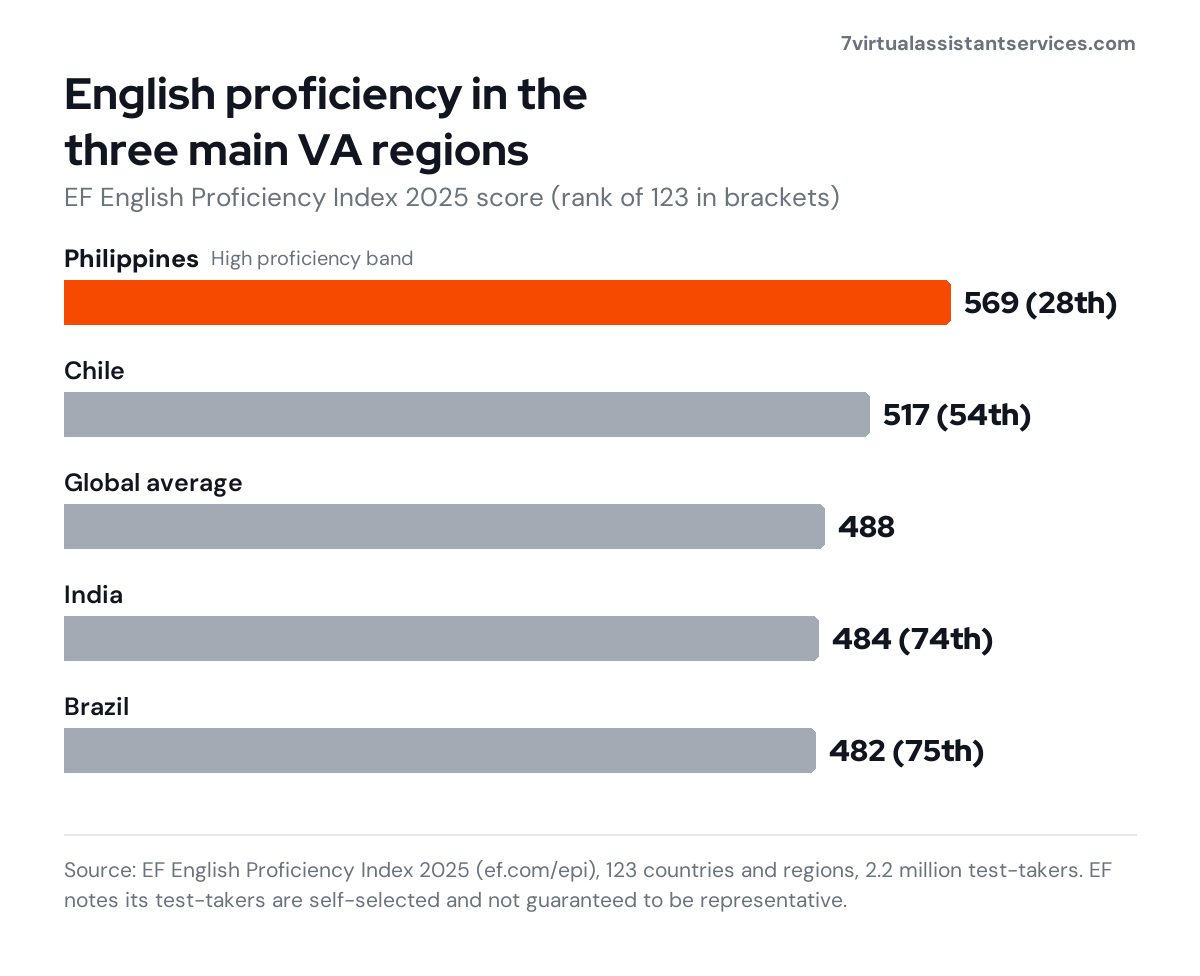
Two cautions before you treat this as the final word. First, EF says its test-takers are self-selected and “not guaranteed to be representative” of the whole population. Second, a national average tells you nothing about the one person you hire.
A VA who has spent years writing to US or UK clients will usually write better than the average for their country, wherever they live. So test the individual. A 15-minute video call and a short written task (reply to a tricky customer email, say) will tell you more than any ranking.
For more on each country, see what it’s like to work with a virtual assistant in the Philippines or a virtual assistant in India, or browse our virtual assistant statistics for 2027.
Time zones: who’s awake when you are?
This is where the regions really differ. Neither the Philippines (UTC+8) nor India (UTC+5:30) uses daylight saving. Brazil’s main business hubs run on UTC−3 all year, since Brazil dropped daylight saving in 2019. Mainland Chile switches between UTC−4 and UTC−3: its summer time began on 5 September 2026 and runs until the first Saturday of April 2027.
Here’s what your 9am to 5pm looks like on your VA’s clock right now, with the US, UK and Europe on standard time (November to mid-March).
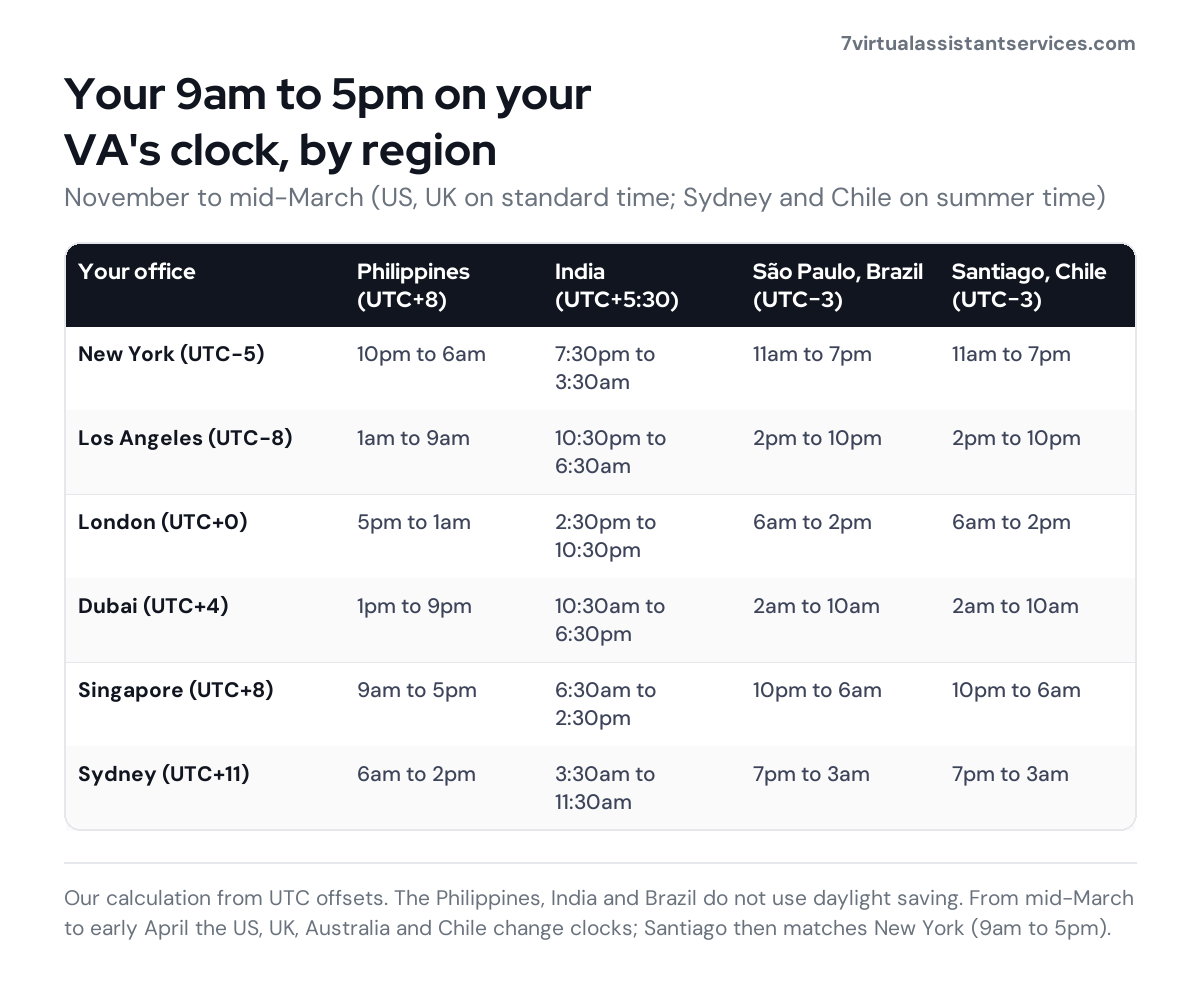
The times move when your clocks change:
- US: daylight saving starts on 14 March 2027. From then, New York’s 9am is 9pm in the Philippines and 6:30pm in India. Once Chile leaves summer time in early April, Santiago’s clock matches New York’s exactly until September.
- UK: British Summer Time starts on 28 March 2027. An India-based VA then covers your whole day from 1:30pm to 9:30pm.
- Australia: Sydney leaves daylight saving on 4 April 2027. A Philippines-based VA then covers your day from 7am to 3pm.
What this means in practice:
- US businesses: Latin America is the only one of the three where your VA works a normal local day while you work yours. Philippines-based and India-based VAs commonly work US hours on a night shift. That works well for many clients, but ask how night-shift cover is handled if your VA is ill.
- UK businesses: India is the easy fit. An afternoon-to-evening shift in India covers your full day. An early shift in Brazil or Chile works too. More on our UK virtual assistant page.
- UAE businesses: India’s working day lines up almost exactly with Dubai’s (10:30am to 6:30pm in India). See VA services in the UAE.
- Singapore businesses: the Philippines shares your clock. India works too, with an early start. See VA services in Singapore.
- Australian businesses: the Philippines is the natural choice, with a morning-to-afternoon shift. See VA services in Australia.
A time gap isn’t always a problem. If most of your work is email, research, data entry or bookkeeping, an overnight VA means it’s done when you wake up. You only need live overlap for calls, chat and same-day back-and-forth.
How big is the outsourcing industry in each region?
Industry size tells you how deep the talent pool is and how easy it is to replace someone.
The Philippines: the IT and business process management (IT-BPM) industry earned $40 billion in 2025 and employed 1.9 million people, according to the industry body IBPAP. It expects $42.3 billion and 1.96 million jobs in 2026, and is targeting up to $50.5 billion and 2.14 million jobs by 2028. The industry is best known for customer support and contact centers.
India: Nasscom estimates India’s tech industry at $315 billion in FY26, including a business process management segment worth $59 billion. The wider tech industry directly employs 5.95 million people. India is especially strong in IT, finance and accounting back-office work.

Latin America: we couldn’t find one industry body that publishes a comparable figure for VA and back-office work across the region, so we’ve left it out rather than guess. The talent is real, but it’s spread across many countries.
How much does a virtual assistant cost in each country?
Honest answer: there’s no reliable official data on VA rates by country, so I won’t give you made-up ranges. What you can compare is what providers actually charge. These are published prices we checked on 31 October 2026, shown by type of provider.
| Option | Where VAs are based | Published price | Cost per hour |
|---|---|---|---|
| 7VAS | India and the Philippines, plus bilingual VAs in Brazil and Chile | Plans from $699/month for 80 hours and $999/month for 160 hours | from $6.24 |
| Other managed company | Philippines | $1,600/month for 160 hours, plus an onboarding fee | $10 |
| Job board (hire yourself) | Philippines | $69 to $99/month job-board fee, plus the worker’s pay | You set it |
| Hourly-block companies | India | from $130 to $160 for 10 hours | $7.50 to $16 |
| Placement company | Latin America | $1,600 to $2,900/month (Starter), hours not stated | Not stated |
The pattern is clear: the business model moves the price more than the country does. Hiring a freelancer yourself is cheapest on paper, but you do the recruiting, training, managing and covering when they’re off. A managed provider costs a monthly fee but handles that for you.
At 7VAS, every plan includes a dedicated VA, a trained backup VA, a QC reviewer and an account manager, month to month with no recruitment fees. You can see the full breakdown on our pricing page. Whoever you choose, check what happens when your VA is sick or on leave, and whether there’s a minimum term.
Do you need a VA who speaks Spanish or Portuguese?
If you sell in the US, this can decide it for you. More than 1 in 5 people aged 5 and over in the US (22%) speak a language other than English at home, and about 61% of them speak Spanish (US Census Bureau, 2017–2021 data).
Latin America is the obvious place for Spanish and Portuguese. Chile is Spanish-speaking and Brazil is Portuguese-speaking, so a VA there can handle customer calls, emails and social media in the language your customers prefer. English is an official language in the Philippines and is widely used in Indian business and higher education, so both are strong for English-only work.
We offer bilingual virtual assistants in Spanish, French, German, Arabic, Portuguese and Chinese (Mandarin and Cantonese). If phone work is the main job, our customer service virtual assistant page explains how that’s set up.
Is your data safe with an offshore VA?
All four countries have a national data-protection law. Here’s where each stands as of 1 November 2026.
| Country | Main law | Regulator | Status |
|---|---|---|---|
| Philippines | Data Privacy Act of 2012 (Republic Act 10173) | National Privacy Commission | Approved 15 August 2012 |
| India | Digital Personal Data Protection Act 2023 | Data Protection Board of India | Rules notified November 2025 with an 18-month phased rollout; core duties from 13 May 2027 |
| Brazil | LGPD (Law 13,709/2018) | ANPD | In force; fines up to 2% of Brazil revenue, capped at R$50 million per infraction |
| Chile | Law 21,719, replacing Law 19,628 of 1999 | New Personal Data Protection Agency | Due 1 December 2026; the Senate voted in late October 2026 to delay it to 15 October 2027, pending the lower house |
Here’s the part most comparisons miss. Your customers’ data is mostly governed by your own country’s law, not the VA’s. The Philippine Act excludes personal information collected from residents of foreign jurisdictions under those countries’ laws (Section 4). India’s framework puts minimal obligations, mainly security safeguards, on Indian firms processing foreign people’s data under a cross-border contract. Either way, you stay responsible for your customers’ data.
So safety comes down to controls, not geography:
- A signed NDA and a written data-handling agreement.
- Your VA works inside your own systems, so data stays in your accounts.
- Share logins through a password manager, never by email or chat.
- Turn on two-factor authentication and give the minimum access each task needs.
- Remove access the same day someone leaves.
At 7VAS, every VA signs an NDA and works inside the client’s own systems, for exactly these reasons.
Which region suits which business?
| If you are… | Best fit | Why |
|---|---|---|
| A US business that needs live help in your day (calls, chat, quick replies) | Latin America | Brazil and Chile work through your business day |
| A US business that wants work done overnight (inbox, research, data entry, bookkeeping) | Philippines or India | Your morning starts with the work finished |
| A US business with Spanish-speaking customers | Latin America | Spanish is a native language, not a second one |
| A UK business | India, or Latin America for early cover | India covers your day on an afternoon shift |
| A UAE business | India | Almost the same working day |
| A Singapore business | Philippines | Same time zone |
| An Australian business | Philippines | Morning-to-afternoon shift covers your day |
| Customer-facing voice work where English accent matters most | Philippines | Highest English rank of the three, big contact-center industry |
| Accounting and finance back office | India | Deep finance and back-office talent pool |
If you’re in the US, our US virtual assistant page covers time-zone options in more detail. For accounting work, see how an accounting virtual assistant fits alongside your accountant.
Frequently asked questions
Is it worth it to have a virtual assistant from the Philippines?
For most admin, customer support and back-office work, yes. The Philippines ranks 28th of 123 in the EF English Proficiency Index 2025, its IT-BPM industry employed 1.9 million people in 2025, and its time zone suits Singapore and Australia. For US clients, the VA usually works your hours on a night shift, so ask how cover works if they’re off.
Philippines or India for a virtual assistant?
Choose the Philippines if spoken English on calls matters most or you’re in Singapore or Australia. Choose India if you’re in the UK or UAE, where the working day overlaps far better, or if you need finance, accounting or IT back-office skills. For US clients, both usually work a night shift, so the individual VA matters more than the country.
Which country has the best English for outsourcing?
Among the main VA countries, the Philippines ranks highest in the EF English Proficiency Index 2025 at 28th of 123, ahead of Chile (54th), India (74th) and Brazil (75th). EF notes its test-takers are self-selected, so always test the person you plan to hire with a call and a written task.
Do Philippine VAs work US hours?
Yes, many do, on a night shift. In US winter, 9am to 5pm in New York is 10pm to 6am in the Philippines; from mid-March it’s 9pm to 5am. Ask whether the VA works that shift long term and who covers when they’re unavailable.
Are Latin American VAs better for US time zones?
Yes, for live overlap. A VA in São Paulo or Santiago works 11am to 7pm local time to cover New York’s 9am to 5pm in US winter, and Santiago matches New York exactly in the US summer. If your work can be done overnight, a Philippines-based or India-based VA can be just as effective.
Is my data safe with an offshore VA?
It can be, if the right controls are in place. The Philippines, India, Brazil and Chile all have data-protection laws, but your customers’ data is still mainly governed by your own country’s law. Insist on an NDA, keep your VA working inside your own systems, share logins through a password manager and use two-factor authentication.
How much does a VA from each country cost?
There’s no reliable official rate by country, and published prices depend more on the provider than the location. In our 31 October 2026 check, full-time managed plans worked out at about $6 to $10 an hour, with 7VAS at the low end ($6.24), India-based hourly blocks cost $7.50 to $16 an hour, and one Latin American provider listed $1,600 to $2,900 a month without stating hours.
The bottom line
There’s no single best country for a virtual assistant. The Philippines leads on English, India on back-office depth and UK, UAE and Singapore overlap, and Latin America on US time zones and Spanish. Start with the hours you need covered and the work you’re handing over, then test the individual VA, not the country.
If you’d like help working out which region fits your business, take a look at our virtual assistant services. You can start with a dedicated VA in 48 to 72 hours, month to month, with a trained backup VA included.

John Peter D
John has worked as a virtual assistant for 16 years and founded 7VAS to give small businesses a dedicated VA with the cover and quality checks he wished his own clients had. His team works from Chennai, India, with Philippines-based VAs and bilingual English–Spanish teams in Brazil and Chile, supporting 200+ clients across the US, UK, UAE, Singapore and Australia.


