- Blog
- Productivity
- Will AI Replace Virtual Assistants? What the 2027 Data Actually Says
Will AI Replace Virtual Assistants? What the 2027 Data Actually Says


Table of contents
- Will virtual assistants be replaced by AI?
- How many small businesses actually use AI?
- What does AI actually do to productivity?
- Can AI act as a virtual assistant?
- AI agent vs virtual assistant: what’s the difference?
- Which tasks can a virtual assistant do that a chatbot can’t?
- When is an AI tool alone enough?
- How do virtual assistants use AI?
- Are AI virtual assistants worth it for small business?
- Frequently asked questions
- The bottom line
Every week, a business owner asks me some version of the same question: “Why would I pay a person when AI can do it?”
Quick answer: No, AI is not replacing virtual assistants in 2027, but it is changing what they do. AI is now very good at individual tasks like drafting, summarizing and sorting, yet the research shows the biggest gains go to people who use it, and Gartner expects over 40% of agentic AI projects to be cancelled by the end of 2027. Someone still has to set the tools up, check the output, make judgement calls and own the result. That someone is increasingly a virtual assistant who works with AI.
I’ve worked as a virtual assistant for 16 years and watched plenty of “this will replace you” tools come and go. This one really does take work off the table. So let’s look at what the data says, and when an AI tool on its own is all you need.
Will virtual assistants be replaced by AI?
Some tasks, yes. The whole role, no.
- AI is replacing tasks: first drafts, meeting notes, inbox sorting, simple data extraction, basic FAQs.
- AI is not replacing ownership: deciding what matters, spotting what’s wrong, handling the awkward client call and making sure the work gets finished.
- The VA who only does copy-and-paste work is under real pressure. The VA who runs AI tools and owns outcomes is in a much stronger position.
The World Economic Forum agrees that clerical work is shrinking. Its Future of Jobs Report expects 170 million jobs to be created and 92 million displaced worldwide by 2030, and it lists administrative assistants and executive secretaries among the fastest-declining roles (World Economic Forum, 2025).
That’s a real warning. But notice what’s declining: routine clerical work. What’s left is the work of making AI output usable and accountable inside a real business. (We cover the wider trends in where the virtual assistant market is heading.)
How many small businesses actually use AI?
It depends who you ask, and the gap between the answers tells you a lot.
- 66% of US small businesses use AI, nearly three times the 23% of 2023 (US Chamber of Commerce, 2026).
- 77% of US small and mid-sized businesses use AI regularly, and 78% say it has improved productivity (Intuit QuickBooks AI Impact Report, 2026).
- But only 19.8% of US businesses use AI to produce their goods or services, and fewer than 20% of firms with four or fewer employees do (US Census Bureau, 2026).
- In the UK, 29% of businesses with fewer than 10 employees use at least one AI technology (ONS, Oct 2026).

Why the big spread? The industry surveys count any use, like drafting an email in ChatGPT. The Census Bureau and ONS ask whether AI is part of how the business actually produces its work.
So most small businesses have tried AI. Far fewer have built it into their operations. That gap, between “I use ChatGPT sometimes” and “AI runs part of my back office,” is exactly where a person is still needed. For the full set of numbers, see our virtual assistant statistics for 2027.
What does AI actually do to productivity?
The research is encouraging, but read it carefully.
- A study of customer support agents found an AI assistant raised productivity by 14% on average and 34% for novice and low-skilled workers, with minimal impact on experienced and highly skilled workers (NBER, 2023).
- US workers using generative AI saved 5.4% of their work hours, about 2.2 hours a week (Federal Reserve Bank of St. Louis, 2025).
- Consultants using GPT-4 on suitable tasks finished over 12% more tasks, over 25% faster, with over 40% higher human-rated quality. The same researchers describe a “jagged frontier”: AI excels at some tasks and falls short at others (Harvard Business School & BCG, 2023).
- In Australia’s government Copilot trial, users reported saving around an hour a day on summarizing, first drafts and searching (Digital Transformation Agency, 2024).
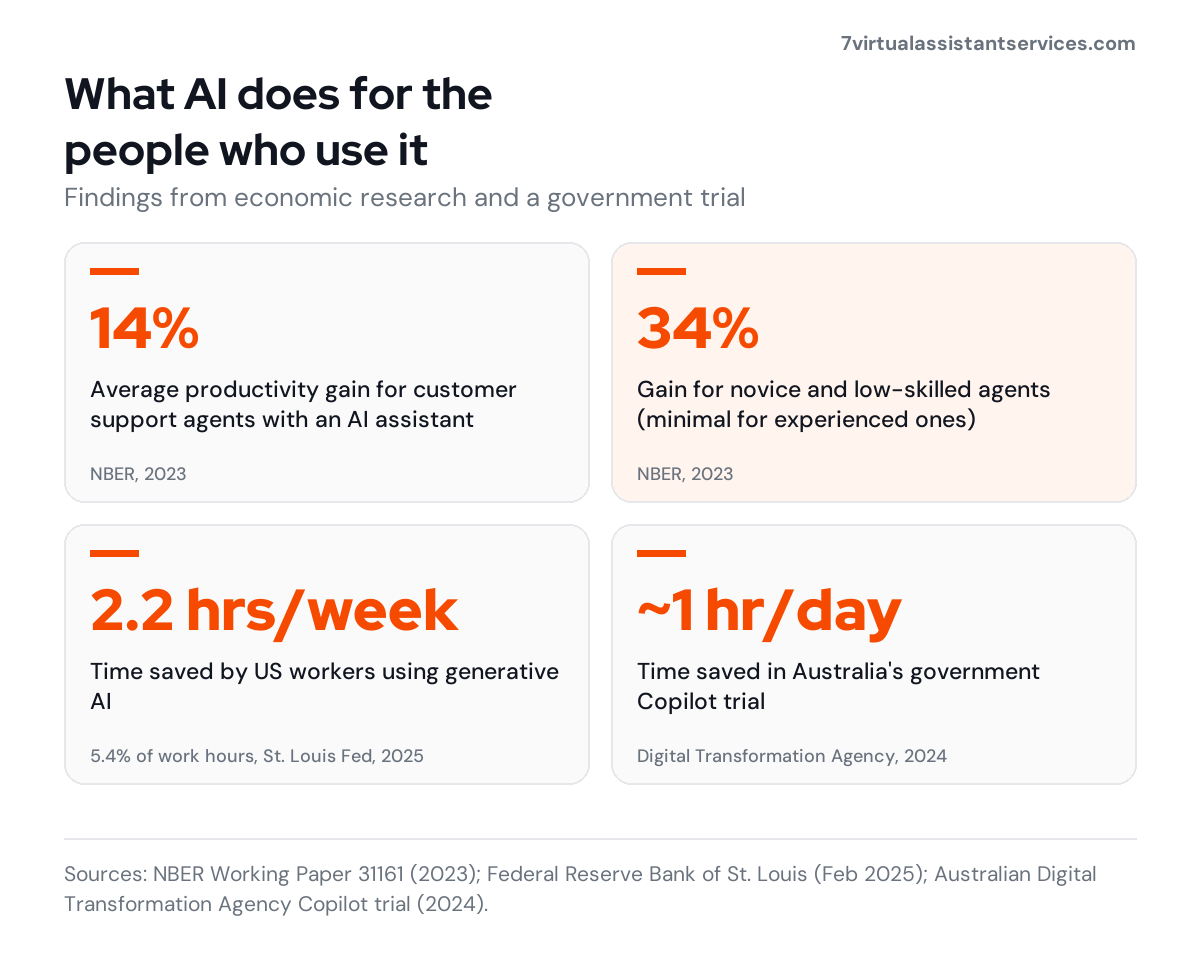
Notice the pattern. In every study, AI makes a person faster. None of them measured AI running a business’s admin unsupervised.
And the jagged frontier matters. AI is strong on a first draft and shaky on details it wasn’t given, so you need someone who knows which side of the line a task falls on.
Can AI act as a virtual assistant?
Partly. “AI virtual assistant” and “AI executive assistant” tools are genuinely useful. A good one today can:
- Draft and reply to routine emails
- Summarize meetings and long threads
- Suggest meeting times and send calendar links
- Pull data out of invoices, forms and PDFs
- Answer common customer questions from a knowledge base
- Write first drafts of posts, proposals and reports
What it can’t reliably do yet is own any of that. It won’t notice that a client who always replies fast has gone quiet for a week, or chase the supplier who keeps “forgetting” the signed contract.
An AI executive assistant is a powerful tool. It’s not yet an accountable member of your team.
AI agent vs virtual assistant: what’s the difference?
An AI agent is software that can take a goal and carry out several steps on its own, such as reading an email, checking a calendar and booking a meeting. A virtual assistant is a trained person who works remotely inside your systems and is responsible for results.
The agent pitch is that software will soon do the whole job. Gartner is more cautious:
- Over 40% of agentic AI projects will be cancelled by the end of 2027, due to escalating costs, unclear business value or inadequate risk controls (Gartner, 2025).
- Gartner calls out “agent washing” and estimates only about 130 of the thousands of agentic AI vendors are real (Gartner, 2025).
- Even so, it expects at least 15% of day-to-day work decisions to be made autonomously by agentic AI by 2028 (Gartner, 2025).
Read that both ways. Agents are coming, but 15% of decisions leaves 85% that aren’t, and companies with IT teams are cancelling many of their projects. A five-person business with no IT team will find it harder, not easier.

Which tasks can a virtual assistant do that a chatbot can’t?
Here’s the practical split I use when clients ask what to automate and what to delegate.
| Area | AI does well on its own | Needs a person | Best done by a VA using AI |
|---|---|---|---|
| Drafting replies, sorting, summarizing threads | Deciding what’s urgent, sensitive replies | Daily inbox triage with AI drafts, checked before sending | |
| Calendar | Offering open slots, sending booking links | Juggling priorities and VIPs, rescheduling diplomatically | Full calendar management with AI scheduling tools |
| Bookkeeping | Reading receipts and invoices | Querying odd transactions, chasing missing paperwork | Faster data entry and reconciliation prep for your accountant |
| Customer service | Answering common FAQs | Complaints, refunds, upset customers | AI handles simple questions, the VA handles the rest |
| Research | Summarizing sources | Judging which sources are reliable | Faster research briefs with checked facts |
| Content | First drafts, captions, outlines | Brand voice, accuracy, what not to post | Planned, edited and scheduled content |
| Systems | Running a workflow once it’s built | Setting it up, fixing it when it breaks | Building and maintaining simple automations |
The middle column is the one that matters. Judgement, relationships, exceptions and follow-through are where mistakes cost the most, and they’re the parts AI handles worst. If most of your workload sits there, look at a virtual administrative assistant rather than another software subscription.
When is an AI tool alone enough?
Sometimes it is, and you should save your money.
An AI tool on its own is probably enough if:
- You get a manageable amount of email and just want help drafting replies.
- Your calendar is simple and a booking link does the job.
- Your customer questions are repetitive and a chatbot with a good FAQ covers most of them.
- You have the time to set up the tools and check the output.
If that’s you, start with the AI features already in your email, office suite or accounting software. You may not need anyone.
You probably need a person when the work is ongoing, involves other people, or costs you money when it goes wrong. Missed follow-ups, a client who got the wrong invoice, a lead nobody called back: these are ownership problems, not drafting problems.
How do virtual assistants use AI?
Good VAs now treat AI like a spreadsheet or a CRM: part of the toolkit. In general, that means:
- Drafting faster. AI writes the first version of an email, report or post, and the VA edits it for accuracy and tone.
- Summarizing. Long threads, meeting recordings and documents get condensed so you read the key points, not the whole thing.
- Cleaning data. AI helps extract and format information, and the VA checks it before it goes into your systems.
- Research. AI speeds up the first pass, and the VA verifies the sources.
- Small automations. Recurring steps get automated, and the VA monitors them and fixes them when they break.
This matches the research. The Microsoft Work Trend Index found that 66% of knowledge workers who use AI say it gives them more time for high-value work, and 58% produce work they couldn’t a year ago (Microsoft, 2026). 76% of workers are comfortable using AI for administrative tasks (Microsoft, 2023).
One honest caveat: the NBER study found the biggest gains went to newer workers, with minimal impact on experienced ones. That suggests AI narrows the gap on routine tasks. It doesn’t replace the experience to know when the output is wrong. At 7VAS, our team VAs have at least 2 to 3 years of experience before placement, and we also have highly experienced VAs with 5 to 7+ years. Every plan includes a QC reviewer, because checking the work matters more, not less, when AI is involved.
To get the most out of your virtual assistant, agree upfront which tasks they should automate and which you want handled personally.
Are AI virtual assistants worth it for small business?
Yes, as a tool. AI assistants cost far less than a person, and the studies above show real time savings. But “worth it” depends on what you’re buying:
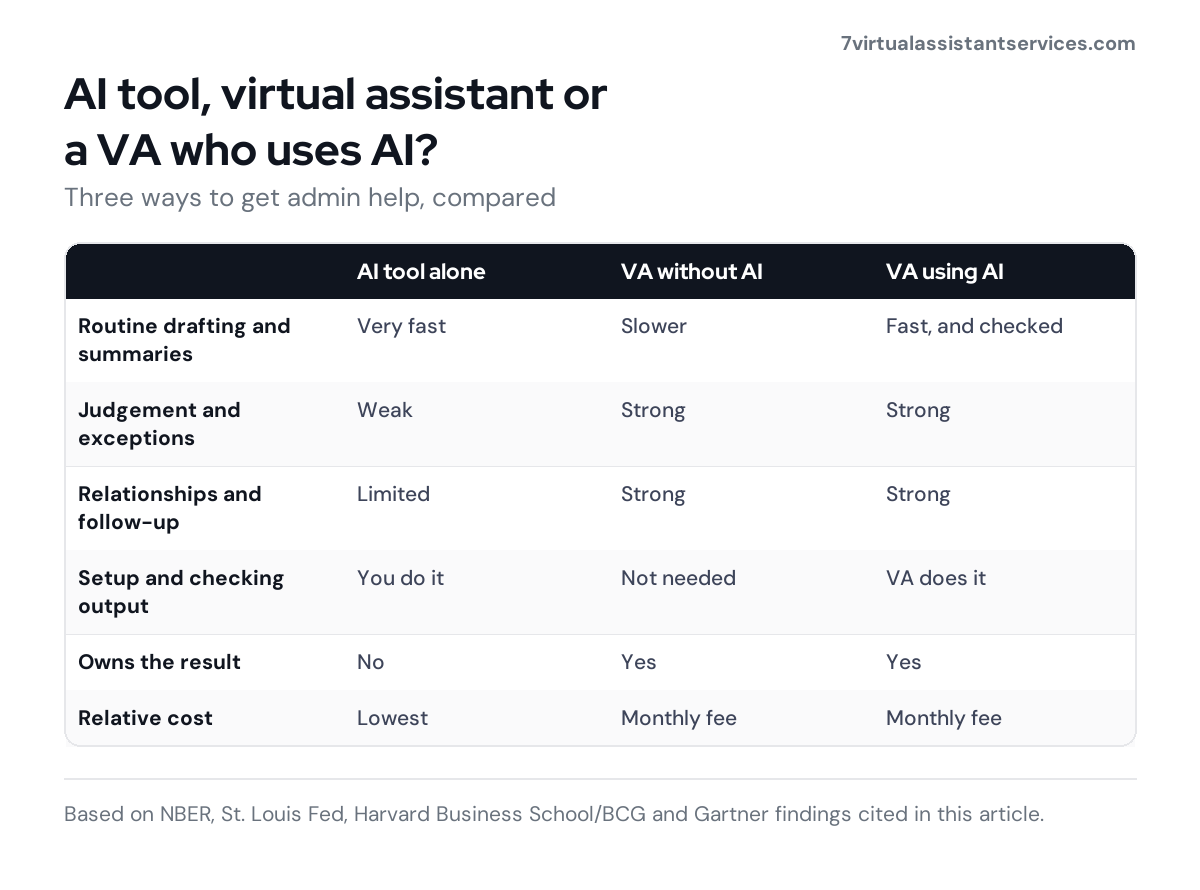
- An AI tool gives you speed on tasks. You still do the setup, the checking and the follow-through.
- A virtual assistant gives you a person who owns a chunk of your workload.
- A VA who uses AI gives you both: the speed of the tools plus someone accountable for the result.
Leaders are moving that way. 82% of leaders plan to use “digital labour” to expand workforce capacity within 12 to 18 months (Microsoft, 2025), and 80% of McKinsey’s respondents say AI has improved their individual productivity (McKinsey State of AI, 2026). Neither says the people go away.
A useful middle path is the one many businesses use for phones: an AI line takes the simple calls, and a customer service virtual assistant handles anything that needs judgement. The same idea works for email management, calendar management and bookkeeping.
If you’re comparing costs, a managed VA at 7VAS starts at US$699 a month for 80 hours on our price plans, month to month with no lock-in. That’s more than an AI subscription, and a lot less than a full-time hire.
Frequently asked questions
Will virtual assistants be replaced by AI?
Not in 2027. AI is replacing individual tasks such as drafting, summarizing and sorting, and the World Economic Forum lists administrative assistants and executive secretaries among the fastest-declining roles by 2030. But someone still has to own outcomes, and Gartner expects over 40% of agentic AI projects to be cancelled by the end of 2027. The VA role is shifting towards assistants who use AI to deliver more.
Can AI act as a virtual assistant?
Partly. AI tools can draft emails, summarize meetings, suggest meeting times, extract data and answer common questions. They can’t yet take responsibility for results, manage relationships, handle exceptions or follow up with people who don’t reply, so most businesses still need a person to run and check them.
Which tasks can a virtual assistant do that a chatbot can’t?
A virtual assistant can make judgement calls, handle sensitive or upset customers, chase people for missing information, notice when something is off, manage priorities across your calendar and inbox, and set up and fix the tools themselves. A chatbot answers what it’s asked; a VA owns the outcome.
What is the difference between an AI agent and a virtual assistant?
An AI agent is software that can carry out several steps towards a goal on its own. A virtual assistant is a trained person working remotely inside your systems who is accountable for results. Gartner expects at least 15% of day-to-day work decisions to be made by agentic AI by 2028, but warns that only about 130 of thousands of agentic AI vendors are genuine.
How do virtual assistants use AI?
Virtual assistants use AI to draft emails and documents, summarize threads and meetings, extract and clean data, speed up research and run simple automations. The VA then checks the output for accuracy and tone before it reaches you or your clients, which is where most of the value comes from.
Are AI virtual assistants worth it for small business?
Yes, as a tool. Studies show real time savings, such as about 2.2 hours a week for workers using generative AI (St. Louis Fed). An AI tool alone is enough for light, repetitive work. For ongoing work involving other people or money, a virtual assistant who uses AI usually gives better results.
Is an AI executive assistant better than a human one?
For scheduling links, meeting notes and first drafts, an AI executive assistant is fast and cheap. For managing priorities, protecting your time, handling VIPs and following through, a human executive assistant is still better, and a human assistant who uses AI tools gets the benefits of both.
The bottom line
AI won’t replace virtual assistants in 2027. It will replace the parts of the job that never needed a person, and it will make the good assistants faster.
If an AI tool covers what you need, use it. If you need someone to own the work, check the output and deal with the people side, that’s where a VA who uses AI earns their keep.
Want to see how that would work for your business? Explore our virtual assistant services and tell us which tasks you’d hand over first.

John Peter D
John has worked as a virtual assistant for 16 years and founded 7VAS to give small businesses a dedicated VA with the cover and quality checks he wished his own clients had. His team works from Chennai, India, with Philippines-based VAs and bilingual English–Spanish teams in Brazil and Chile, supporting 200+ clients across the US, UK, UAE, Singapore and Australia.


