
- Blog
- Hiring & cost
- Outsourcing Bookkeeping: Costs, Risks and What to Hand Off First
Outsourcing Bookkeeping: Costs, Risks and What to Hand Off First

Table of contents
- Why are so many small businesses outsourcing bookkeeping?
- What are your options for outsourcing bookkeeping?
- Which option should you choose?
- What bookkeeping tasks should you hand off first?
- What should stay with your accountant?
- Is outsourcing bookkeeping safe?
- How do you get started without a mess?
- Frequently asked questions
- The bottom line
If your books are three months behind and tax season is coming, you’re not alone, and you don’t need to hire a full-time bookkeeper to fix it.
Quick answer: Outsourcing bookkeeping means paying an outside firm or a remote assistant to keep your books current while your accountant still reviews them and files your taxes. In the US, an in-house bookkeeper earns a median of $50,670 a year before benefits, while outsourced options run from about $1,200 to $10,800 a year, depending on how much hands-on help you need. Start with bank feeds, categorization and reconciliations, keep payments and tax filing with people you control, and give access through user roles, never shared passwords.
I’ve worked as a virtual assistant for 16 years. This guide covers what each option costs, what to hand off first, what should stay with your accountant and how to keep your money safe while someone else does the data entry.
Why are so many small businesses outsourcing bookkeeping?
Because the books are the job that always slides to next week.
US small business owners lose 33 working days a year to tax and financial stress, according to a 2026 Xero study. In the UK, SME owners spend about 11 hours a week on admin and finance (American Express, 2026), and each small firm spends roughly £4,500 and 44 hours a year on tax compliance (FSB).
That time comes out of sales, customers and sleep. And when books are late, your accountant bills more at year end to clean them up. Our virtual assistant statistics roundup has more data on the admin load small business owners carry.
What are your options for outsourcing bookkeeping?
You have four realistic choices. Each suits a different kind of business.
1. Hire an in-house bookkeeper. The US median pay for bookkeeping, accounting and auditing clerks is $50,670 a year, or $24.36 an hour (BLS, May 2025). Benefits add more: for office and administrative support workers, employers pay $36.73 an hour in total for every $25.22 in wages. Apply that ratio and a median bookkeeper costs about $73,800 a year, before recruiting, equipment and training.
2. Use an outsourced bookkeeping firm. You send them access to your bank and receipts, and they deliver monthly financial statements. Prices on public pricing pages, checked on 1 November 2026:
- Bench: Bookkeeping $399/month ($3,830/year paid annually), Bookkeeping + Tax $649/month, and Bookkeeping Light $199/month for businesses with $250K or less in revenue.
- Bookkeeper360: bookkeeping from $400/month with a US-based team; tax returns from $1,200/year extra.
- Pilot: Essentials $99/month, an AI-led plan for businesses with up to $100,000 in monthly expenses. Its Core plan adds a US-based bookkeeper, but the starting price wasn’t shown on the page when we checked.
3. Hire a bookkeeping or accounting virtual assistant. A dedicated person works inside your own QuickBooks or Xero file, usually on more than just the ledger: bills, invoices, receipts and payroll inputs too. At 7VAS, accounting VAs start from US$899/month, and your accountant still reviews and files.
4. Software only, and do it yourself. Xero’s US plans are $27, $59 and $97 a month at full price, and QuickBooks Online lists Simple Start at $38, Essentials at $85 and Plus at $140 a month before promotions. It’s the cheapest option on paper. The real cost is your time.
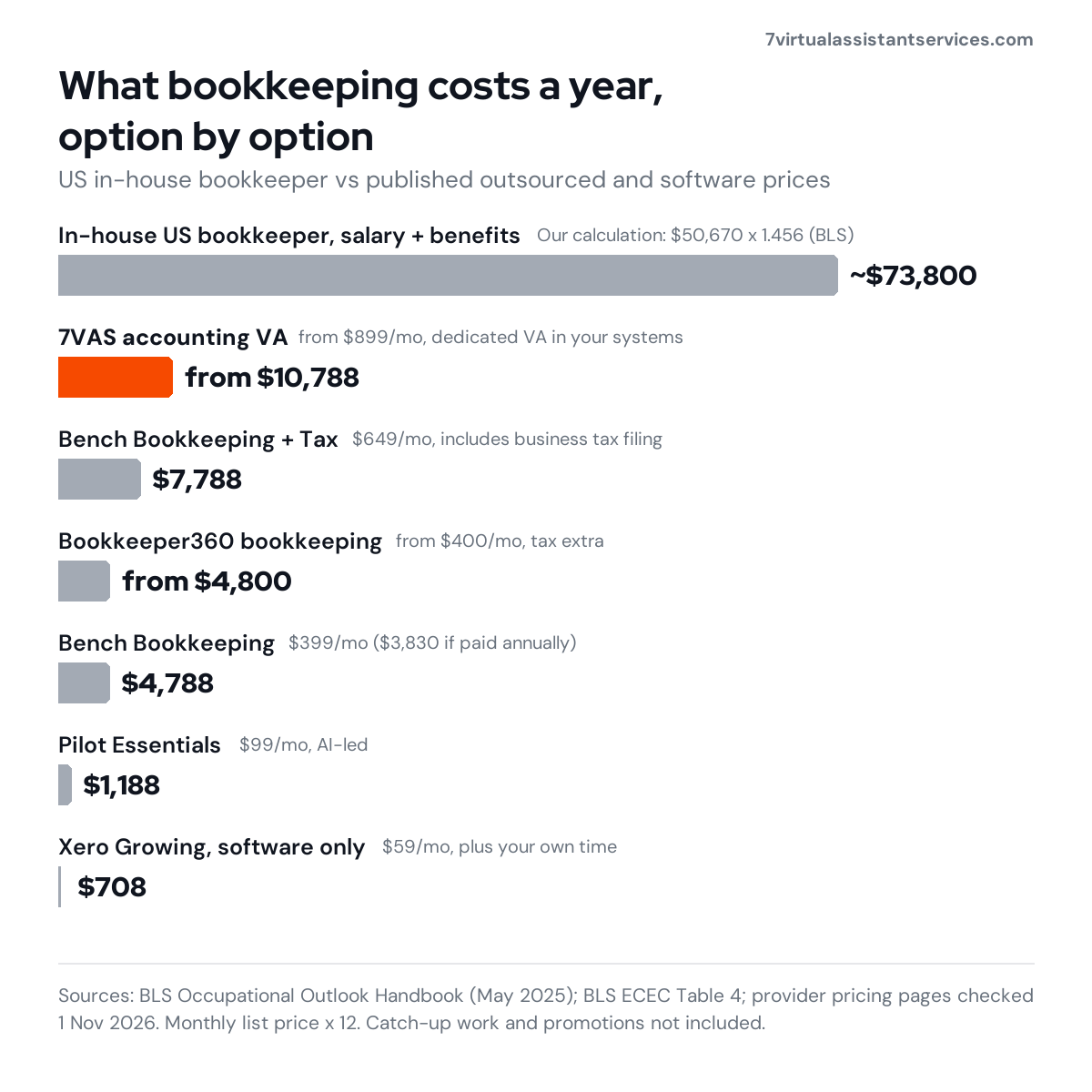
Here’s how they compare side by side.
| Option | Annual cost | Who does the work | Best for |
|---|---|---|---|
| In-house bookkeeper (US) | ~$73,800 with benefits | Your employee, on site | High transaction volume, complex inventory, need someone in the office |
| Bookkeeping firm | ~$1,200 to $7,800 | A team in the firm’s process | Simple books, monthly statements, little else needed |
| Bookkeeping/accounting VA | From $10,788 (7VAS) | One dedicated person in your systems | Books plus bills, invoices, receipts and finance admin |
| Software only | ~$324 to $1,680 | You | Very small, low-volume businesses with spare time |
Our calculation: monthly list price × 12. In-house: $50,670 × 1.456 (BLS ECEC ratio for office and admin support). Firm prices exclude catch-up work, which is often extra.
Which option should you choose?
Be honest about what you actually need.
Choose a bookkeeping firm if you want fully done-for-you books, your transactions are fairly simple and you’d like tax filing bundled in. Bench’s Bookkeeping + Tax plan includes licensed tax professionals and business tax filing, which is convenient if you don’t already have an accountant. For many sole traders and small service businesses, a firm is cheaper than a VA, and that’s fine.
Choose a bookkeeping VA if the problem is bigger than categorizing transactions. Maybe you have 60 vendor bills a month, customers who pay late and a shoebox of receipts. A firm keeps the ledger. A VA also chases the paperwork, follows up on invoices and preps everything your accountant needs. You keep your existing accountant, and you get one named person who knows your business.
Choose in-house if you need someone on site handling inventory, cash or physical documents every day, or your volume justifies a full-time salary.
Stay with software only if you have fewer than a few dozen transactions a month and genuinely enjoy the work. Most owners don’t.
If you’re weighing firms against VA companies more broadly, our price plans show what a dedicated VA costs and what comes with it.
What bookkeeping tasks should you hand off first?
Don’t hand over everything on day one. Start with the repetitive work that’s easy to check, then build up as trust and accuracy grow.
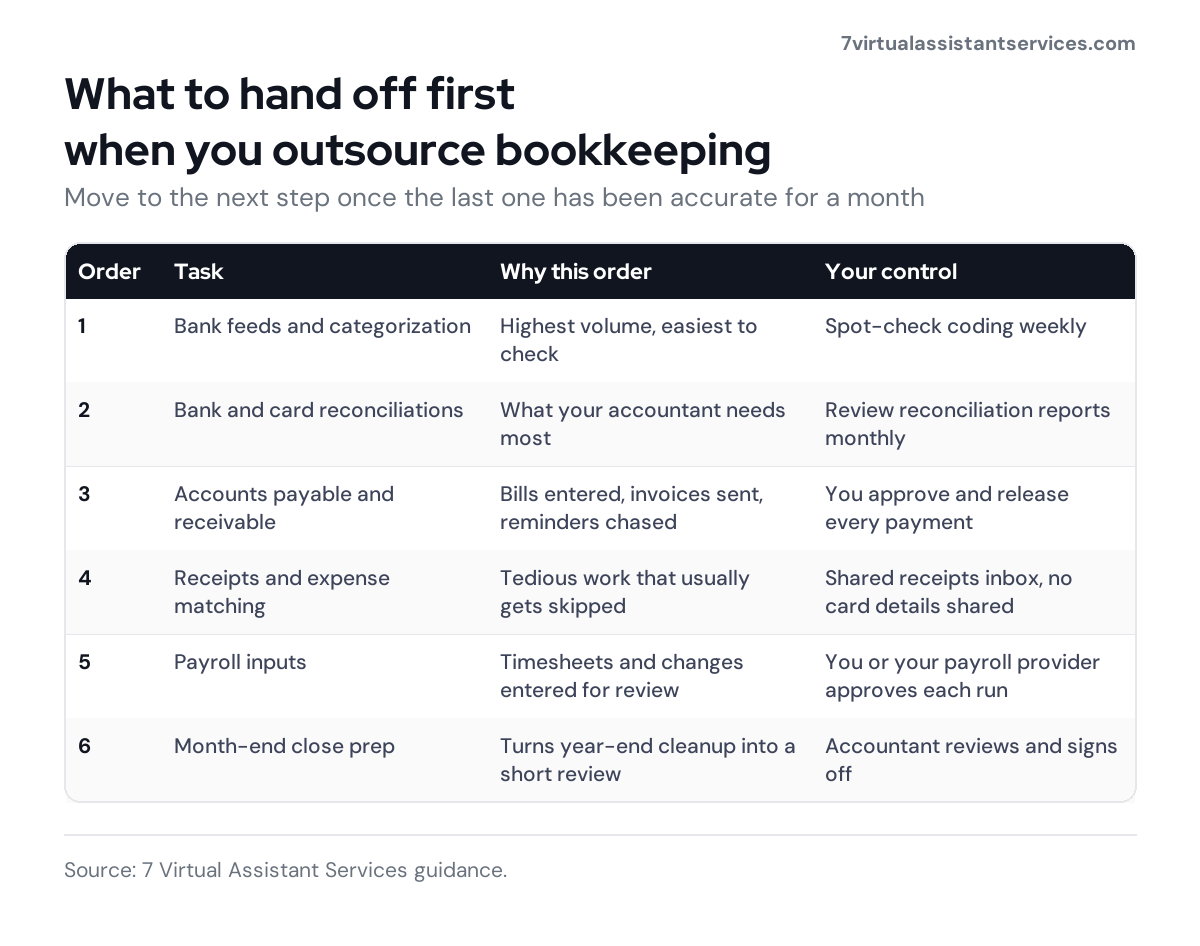
1. Bank feeds and transaction categorization. This is the highest-volume, lowest-risk task. Your VA or bookkeeper connects feeds, codes transactions to the right accounts and flags anything unclear. You can check their work in minutes.
2. Bank and credit card reconciliations. Once coding is reliable, have them reconcile every account monthly, then weekly if you’re busy. Reconciled books are what your accountant needs most.
3. Accounts payable and receivable. Entering bills, matching them to purchase orders, raising invoices and sending polite reminders. Keep one rule: they prepare payments, you approve and release them. An accounts payable virtual assistant can run this whole cycle up to the approval step.
4. Receipts and expense matching. Collecting receipts from email and apps, matching them to transactions and chasing the missing ones. It’s tedious, which is exactly why it gets skipped. Much of this overlaps with general data entry support.
5. Payroll inputs. Gathering timesheets, new-starter details and expense claims, then entering them into your payroll software for your review. You or your payroll provider still approves each run.
6. Month-end close prep. A checklist of reconciliations, open items, accruals to consider and questions for your accountant. This turns your accountant’s review into an hour of checking instead of a week of cleanup.
What should stay with your accountant?
Your outsourced help keeps the records. Your accountant reviews them, gives advice and deals with the tax authority. That split matters legally in most of the markets we serve.
In the US, anyone with a PTIN can be a paid tax return preparer, but only enrolled agents, CPAs and attorneys have unlimited representation rights before the IRS. In Australia, anyone providing BAS services for a fee must be registered with the Tax Practitioners Board unless an exemption applies.

| Market | Common software | What outsourced help prepares | Who reviews and files |
|---|---|---|---|
| United States | QuickBooks Online, Xero, Bill.com, Gusto | Bookkeeping, reconciliations, AP/AR, payroll inputs, 1099 data, year-end workpapers | Your CPA or enrolled agent files with the IRS |
| United Kingdom | Xero, QuickBooks, Sage, Dext | Bookkeeping and the digital VAT records Making Tax Digital requires | You or your authorized agent submits VAT returns to HMRC |
| Australia | Xero, MYOB, QuickBooks | Reconciliations and BAS workpapers | Your registered BAS or tax agent lodges with the ATO |
| UAE | Zoho Books, Xero, QuickBooks | Bookkeeping and records for VAT (5%) and corporate tax | Your tax agent or finance team files with the FTA |
| Singapore | Xero, QuickBooks | Bookkeeping and records for GST (9%) | Your accountant files with IRAS |
Our accounting VAs never sign or file returns. They prepare clean, reconciled records so your accountant spends their time reviewing, not entering data. We place VAs for clients in the US, UK, Australia, UAE and Singapore.
Is outsourcing bookkeeping safe?
It can be safer than doing it yourself, if you set it up properly. The risk isn’t the distance. It’s loose access and nobody checking.
Fraud is a real cost for any business. The ACFE’s 2026 Report to the Nations estimates organizations lose about 5% of revenue to fraud each year, and a typical case runs 12 months before it’s detected. The controls below apply whether your bookkeeper sits in your office or on another continent.
Use proper user roles. QuickBooks Online and Xero both let you invite each person as their own user and limit what they can do. Give your bookkeeper the access the job needs, not admin rights, and remove access the day someone leaves.
Never share passwords. No shared logins to your bank, accounting software or email. Each person gets their own login with two-factor authentication, so every change is traceable to a name.
Separate duties. The person who enters bills shouldn’t also release payments. Let your outsourced help prepare payment batches and let you, or a manager, approve them in the bank. Bank access for the bookkeeper should be view-only or none.
Sign an NDA. Your provider and the individual doing the work should both be bound by confidentiality.
Keep a review cadence. Glance at reconciliations weekly, review the monthly reports and have your accountant check the books at least quarterly. Fraud and errors both hide in books nobody reads.
Own your data. Keep the books in a QuickBooks or Xero file in your name, so you can change providers without losing history. This isn’t theoretical: Bench told customers its platform would no longer be accessible from 27 December 2024, and Employer.com agreed to buy it days later. Customers who owned their own files had far less to worry about.
How do you get started without a mess?
Pick a quiet month, ideally well before your tax deadline, and follow four steps.
- List what you do now. Write down every finance task you touch in a month and roughly how long it takes.
- Decide who reviews. Confirm your accountant is happy to review the books and tell them who’s joining.
- Set up access properly. Invite your bookkeeper or VA as a limited user, connect bank feeds and share a receipts inbox.
- Start with steps 1 and 2 of the hand-off list. Check the first month’s reconciliations together, then add AP/AR.
If the books are badly behind, budget for catch-up work first. Bookkeeper360 lists cleanup from $1,000, and most providers quote it separately. For a wider view of what to delegate beyond finance, see our guide to outsourcing virtual assistant services.
Frequently asked questions
How much does it cost to outsource bookkeeping?
In the US, public pricing pages checked on 1 November 2026 show bookkeeping firm plans at $99 a month (Pilot Essentials, AI-led), $399 a month (Bench Bookkeeping) and from $400 a month (Bookkeeper360), while dedicated accounting VAs from 7VAS start at $899 a month. That compares with about $73,800 a year for a median US in-house bookkeeper once benefits are added, based on BLS data.
Is outsourcing bookkeeping safe?
Yes, if you control access. Give each person their own login with a limited user role, never share passwords, keep payment approval with yourself, require an NDA and review reconciliations regularly, and keep the books in a software file you own.
What is the difference between a bookkeeper and a virtual assistant?
A bookkeeping firm typically owns the output, delivering monthly statements through its own process and team. A bookkeeping virtual assistant is one dedicated person working inside your QuickBooks or Xero file who also handles finance admin like bills, invoices, receipts and payroll inputs, with your accountant reviewing their work.
Should I outsource bookkeeping or hire in-house?
Outsource if your books take less than full-time hours or you can’t justify a salary of around $50,670 plus benefits. Hire in-house if you need someone on site every day for inventory, cash or physical paperwork, or your transaction volume truly fills a full-time role.
What bookkeeping tasks can I outsource?
Most of the day-to-day work: bank feeds and categorization, reconciliations, accounts payable and receivable, receipt collection, payroll inputs and month-end close prep. Keep payment approval, tax filing and final sign-off with you and your accountant.
Can an outsourced bookkeeper file my taxes?
It depends on who they are and where you are. In the US, anyone with a PTIN can prepare returns for pay, but only CPAs, enrolled agents and attorneys have unlimited representation rights before the IRS, and in Australia BAS services for a fee require TPB registration. 7VAS accounting VAs never sign or file returns; your accountant does.
When should a small business outsource bookkeeping?
Outsource when your books are more than a month behind, when you spend several hours a week on them or when your accountant’s year-end cleanup bill keeps growing. The best time to start is a few months before your tax deadline, so the books are clean when filing season arrives.
The bottom line
Outsourcing bookkeeping isn’t about handing over control. It’s about handing over the data entry, so you and your accountant can focus on decisions.
If simple, done-for-you books are all you need, a bookkeeping firm is a sensible, low-cost choice. If you want one dedicated person keeping your books, bills, invoices and receipts current inside your own systems, a VA is worth a look. Every 7VAS plan includes a dedicated VA, a trained backup VA, a QC reviewer and an account manager, starts in 48 to 72 hours and runs month to month with no lock-in. You can compare all our VA price plans or see how we support small businesses more broadly.
Ready to get your books current before tax season? Hire a bookkeeping virtual assistant →

John Peter D
John has worked as a virtual assistant for 16 years and founded 7VAS to give small businesses a dedicated VA with the cover and quality checks he wished his own clients had. His team works from Chennai, India, with Philippines-based VAs and bilingual English–Spanish teams in Brazil and Chile, supporting 200+ clients across the US, UK, UAE, Singapore and Australia.


